Translate

Thursday, November 18, 2021

Future Fridays: Ent Speed

 [Espanol abajo]

One time our daughter Jessica told me, “Y’all treat everything like it's a crisis... all the time.  You need to chill out more, not everything is a crisis.”


I started paying attention to how we actually reacted to life in general and she was right.  Something would come up and the panic would start to kick in, snapping with each other would get more intense, and tempers would get hot.  I got to a point that when that would start to happen I would think of Jessica and carefully go through my mind slowly, “Is someone bleeding?  No.  Is someone dying?  No.  Okay, chill out and take deep breaths.”


But sometimes, I take too long to act and things fall by the wayside.  We cannot do this when it comes to climate change.


Our son, Daniel sent me this meme.  It definitely hits home!


If you do not know the Lord of the Rings, then you have missed one of the greatest beings imagined... the Ents.  They are tree people meaning trees that are sentient, mobile, and verbal.    And like trees, they are slow... so slow.


The Hobbits accidently encounter an Ent and tell him that the world is in danger.  After taking a long while to convince this Ent, who claims to be impetuous and young, he calls a meeting. It takes days to gather the Ents and then the discussion starts with introductions that take a day or two.  The Hobbits are furious and panicky, but the Ents are slow and deliberate.  The world is in danger!!!!   Sound familiar?


The COP26, a climate conference in Glasgow, started with introductions, then came the well-meaning speeches, and the talks and talks.


But as young people globally are crying out, “The world is in danger!!!!  Let’s get going!!!” the participants continue to talk.


Nicaragua is impacted enormously by climate change.  Their representatives to climate change conferences are a lot like the Hobbits yelling at the Ents to get to moving.  When the agreement on deforestation was reached at the COP26, the Nicaraguan National Assembly passed legislation to enable the government to take out a loan for $108.3 million to reforest and support the bio reserves of the Bosawas and Rio San Juan.  They just up and did that... not much debate.


May the rest of the world follow their example and act now to save trees.  My prayer is that when the nations of the world decide to act, as when the Ents decided to act, then NOTHING... no war machinery, no industrialization, and no evil will stand it their way.  I pray that they will act with force; I just hope it will not be too late.

- Kathleen 


[English above]


Una vez, nuestra hija Jessica me dijo: "Ustedes tratan todo como si fuera una crisis...todo el tiempo. Necesitas relajarte más, no todo es una crisis. "


Empecé a prestar atención a cómo reaccionamos ante la vida en general y ella tenía razón. Algo surgiría y entrabamos en un pánico, a perder la paciencia uno con el otro y los ánimos se calentarían. Llegué a un punto en el que, cuando eso empezara a suceder, pensaba en Jessica y diría lentamente a mi misma: “¿Alguien está sangrando? No. ¿Alguien se está muriendo? No. Está bien, relájate y respira profundo."


Pero a veces, tardo demasiado en actuar y las cosas se quedan en el camino. No podemos hacer esto cuando se trata del cambio climático.


Nuestro hijo, Daniel me mandó este meme. ¡Definitivamente es oportuno!


Si no conoces al Señor de los Anillos, entonces te has perdido a uno de los seres más grandes imaginados ... los Ents. Son personas arbóreas, es decir, árboles que son sensibles, móviles y verbales. Y como los árboles, son lentos ... muy lentos.


Los Hobbits se encuentran accidentalmente con un Ent y le dicen que el mundo está en peligro. Después de tomarse un tiempo para convencer a este Ent que dice ser impetuoso y joven, convoca una reunión. Se necesitan días para reunir a los Ents y luego la discusión comienza con presentaciones que toman uno o dos días. Los Hobbits están furiosos y asustados, pero los Ents son lentos y deliberados. ¡¡¡¡El mundo está en peligro!!!! ¿Suena familiar?


La COP26, una conferencia climática en Glasgow, comenzó con presentaciones, luego vinieron los discursos bien intencionados y el hablar y más hablar.


Pero como los jóvenes de todo el mundo están gritando: “¡¡¡El mundo está en peligro !! ¡¡¡Vámonos!!!" los participantes continúan hablando.


Nicaragua se ve enormemente afectada por el cambio climático. Sus representantes en las conferencias sobre cambio climático se parecen mucho a los Hobbits que les gritan a los Ents que se pongan en marcha. Cuando se alcanzó el acuerdo sobre deforestación en la COP26, la Asamblea Nacional aprobó una ley que permitió al gobierno obtener un préstamo por $ 108,3 millones para reforestar y apoyar las reservas biológicas de Bosawas y el Rio San Juan. Simplemente se levantaron e hicieron eso ... no hubo mucho debate.


Que el resto del mundo siga su ejemplo y actúe ahora para salvar árboles. Mi oración es que cuando las naciones del mundo decidan actuar, como cuando los ents decidieron actuar, entonces NADA ... ninguna maquinaria de guerra, ninguna industrialización ni ningún mal se interponga en su camino. Rezo para que actúen con fuerza, solo espero que no sea demasiado tarde.

- Kathleen


NOTE: If you are reading this blog using the mobile version, click on "web version" to see the full blog with all the features including "subscribe to blog by email".  

Please join us and also share on your social media.

Donate here to the ongoing work of the CDCA with the poor in Nicaragua:
https://donatenow.networkforgood.org/jhc-cdca 


Tuesday, November 16, 2021

When You Can't Afford to Get Sick

[Español abajo]

About a week ago, I got a virus and started throwing up all night.  I would go to bed, lie there, and then jump up, run to the bathroom and get sick.  Clean up all around and wash out my mouth with water...we’ve all been there.


Periodically when I get sick like that I remember getting sick here in Nicaragua in 1985 on a Witness For Peace delegation.  We were sleeping in a school when I started getting sick.  There was an outdoor latrine (or outhouse) and I would wake up and run outside and stand over the latrine (which smells bad on the best of days) and vomit.


Now why would I bring up such graphic and gross things?


El Porvenir Latrine

Someone at El Porvenir, the remote organic coffee cooperative, brought COVID up to their community.  80% of the folks came down with COVID.


Being sick at the best of times is no fun at all.  Being sick and being poor, stuck up on a mountain, is unfathomable to me.  I have had limited experiences of being sick in the campo, the rural areas.  Let me tell you…


  • There is  no running water to clean off or wash your mouth out. 

  •  There are only outdoor pit latrines instead of nice clean toilets to flush down and start fresh for the next bout of sickness. No electricity.

  • There is no way to cool down or heat up when your temperature shoots up or plummets down.  Instead you shiver or sweat. 

  • There is no comfortable bed to lie on to doze in and out, only make-shift pallets.  

  • No screens to keep bugs at bay as you moan and groan. 

  •  No way to keep the chickens and dogs out of your space

  • And no entertainment when you are awake to keep your mind off how bad you feel.


Cooking is so difficult if you are the woman of the house, sick and have a family.  Getting wood, starting a fire, and cooking tortillas, rice and beans. 


No paid sick leave for the farmers….just crops sitting with no one to attend the crops. Nothing is easy.


80% of these folks got sick with COVID.  Thankfully no one died.


Now these folks are grateful, because they have all been vaccinated.  None of them thought twice about not going through that again.


Poverty in health is difficult and hard.  Poverty in sickness is horrid.


No one wants to be sick AND be poor and yet, the poor are the ones who get sick the most. --


Kathleen


[English above]

Hace una semana me enfermé con un virus, pasé la noche vomitando. Me acostaba en la cama, y me levantaba de nuevo para correr al baño y vomitar. Limpiaba, enjuagaba la boca con agua… algo que todos hemos vivido.


Cuando me enfermo así me recuerda de la vez que me enferme acá en Nicaragua en 1985 cuando vine como parte de una brigada de Acción Permanente Por La Paz. Estábamos pasando la noche en un colegio cuando me enfermé. Hubo una letrina afuera, pues yo me despertaba, corría para la letrina (lo cual apeste cualquier día) y vomitaba.


¿Por qué hablo de cosas tan gráficas y asquerosas?

El Porvenir Home

Alguien de la
cooperativa de café orgánica El Porvenir se enfermó con COVID y el 80% de su comunidad también se enfermó.

Estar enfermo cuando estás cómodo es horrible. Estar en enfermo cuando sos pobre y arriba de una montaña…ni lo puedo imaginar. He tenido algunas experiencias de estar enferma en el campo y déjame decirte...

     No hay agua potable para poder lavarse o enjuagar la boca

     Sola hay letrinas en vez de inodoros limpios para deshacer de lo feo y empezar de nuevo

     No hay manera de refrescarte o calentarte mientras tu calentura suba o baja

     No tenés cama cómoda para acostarte y descansar

     No hay mosquiteros para repelar los insectos mientras estés incómodo

     No hay manera de mantener las gallinas y perros lejos de tu espacio

      Y nada de entretenimiento para distraerte de lo malo que sentís


Cocinar es difícil si sos la mujer de la casa, andas enferma y tenés familia que cuidar. Buscar leña, prender el fuego, cocinar tortillas, arroz, y frijoles.


Nada de pago subsidiado para los campesinos. Solo cultivos sin quién los atienda. Nada es fácil.


El 80% de esta gente se enfermó con COVID. Gracias a Dios ninguno falleció.


Ahora esta gente es agradecida porque se ha vacunado. Ni uno pensó que sería buena idea vivir eso de nuevo.


La pobreza es difícil cuando estás bien de salud. La pobreza cuando estás enfermo es horrible.


Nadie quiere estar enfermo y pobre, pero al final los pobres son los que se enferman de más.


– Kathleen, Jubilee House Community

NOTE: If you are reading this blog using the mobile version, click on "web version" to see the full blog with all the features including "subscribe to blog by email".  

Please join us and also share on your social media.

Donate here to the ongoing work of the CDCA with the poor in Nicaragua:
https://donatenow.networkforgood.org/jhc-cdca 

Friday, November 12, 2021

Nicaragua's People Have Spoken

[Español abajo] 


I was on my way back from Managua after spending the day in Leon as an official election accompanier when I saw the White House statement calling the Nicaraguan elections a "sham."


On election day, I watched thousands of Nicaraguans entering polling stations in a steady stream. I saw an efficient process – often taking less than 10 minutes from the time a voter arrived at the voting center to the time they had cast their vote and had their thumb covered in indelible ink – a calm, orderly and respectful atmosphere. We saw elderly, people with disabilities, and entire families coming in together and proudly taking selfies with their inked thumbs up.


The White House, U.S. State Department and the Organization of American States had all released statements calling the elections a "pantomime," undemocratic" and "illegitimate" and U.S. President Joe Biden had already signed the RENACER Act - which will further sanction Nicaragua - into law before the Nicaraguan election authorities had even finalized the count and announced the official election results. 


What do the results show? That even in the middle of a pandemic, with in-person voting, nearly  two-thirds of eligible voters participated (65.26% of anyone aged 16 or older). Of those, 75.87% cast votes for the FSLN, the ruling Sandinista party. The main opposition party, Constitutional Liberal Party (PLC) got 14.33% and four other opposition parties got 3% or less.


Although I am tempted to debunk the U.S. response, others have done so far better than I could (in-depth here, shorter article here). 


More importantly, I want to emphasize that anything Joe Biden or Anthony Blinken or Luis Almagro say does not, and cannot matter. They are not Nicaraguan. They do not represent Nicaragua. 


Nicaragua is a sovereign country, and the Nicaraguan people have spoken. What have they said?


"The importance of today's elections is that we are voting for peace." - Voter, Leon. 


"It is a great privilege to vote; elections are an expression of Nicaragua's sovereignty.” - Voter, Chinandega.


"Although we are sick in health and poor, we are here exercising our right to vote as citizens." -Voter, Chinandega.


“There are members of different political parties here, we are all respecting one another and participating in the electoral process. We want to see what the people think. If a majority of people come out to vote—60 or 70 percent—then the election results will tell us the people support this government. But if fewer than half of the electorate turns out to vote, that will mean that people felt they did not have a real choice in this election" - poll watcher with opposition party PLI, Leon.


"Nicaragua is not perfect. Nicaragua does not have to prove itself worthy. We don't have to earn the right to get the yoke of the United States off of us. Which means we don't have to earn the right not to be bullied, not to be subject to illegal sanctions, and not to be subject to coercion. That is our right. We have the right to experiment, we have the right to chose our development priorities, we have the right to hold our sovereign elections. Those are rights that we have as Nicaraguans." - Sofia Clark, Miguel d'Escoto Study Center, UNAN Managua.


The Nicaraguan people have spoken. The world needs to listen. 


- Becca Mohally Renk, Jubilee House Community


P.S. Please watch all three short videos in this Twitter thread of an 85 year-old Miskito woman in her first-ever interview about her opinions. She is from an area that was hit by two category 4 and 5 hurricanes last year and where the FSLN just won more than 80% of the vote. 

[English Above] 


Estuve en camino de regreso a Managua después de pasar el día en León como acompañante electoral acreditada para las elecciones cuando vi la declaración de la Casa Blanca que calificaba las elecciones de Nicaragua como una "farsa."


El día de las elecciones, vi a miles de nicaragüenses ingresar a los colegios electorales en un flujo constante. Vi un proceso eficiente, que a menudo toma menos de 10 minutos desde que un votante llegaba al centro de votación hasta que colocaba su boleto en las urnas y se le cubrian pulgar en tinta indeleble...una atmósfera tranquila, ordenada y respetuosa. Vimos personas mayores, personas con discapacidades y familias enteras que se reunían y se tomaban fotos con orgullo con sus pulgares entintados hacia arriba.


La Casa Blanca, el Departamento de Estado de EE. UU. Y la Organización de Estados Americanos emitieron declaraciones en las que calificaron las elecciones de "pantomima," "antidemocrática" e "ilegítima" y el presidente de EE. UU. Joe Biden ya había firmado la Ley RENACER, que sancionará aún más a Nicaragua, antes que las autoridades electorales nicaragüenses incluso había finalizado el conteo y anunciado los resultados oficiales de las elecciones.


¿Qué muestran los resultados? Que incluso en medio de una pandemia, con votación precencial, participaron casi dos tercios de los votantes elegibles (65,26% de toda persona mayores de 16 años). De ellos, el 75,87% votaron por el FSLN, el gobernante partido sandinista. El principal partido de oposición, el Partido Liberal Constitucional (PLC) obtuvo el 14,33% y otros cuatro partidos de oposición consiguieron el 3% o menos.


Aunque quisiera desacreditar las acusaciones de EE. UU., otros lo han hecho mucho mejor que yo (en profundidad aquí, artículo más breve aquí).


Más importante aún, quiero enfatizar que cualquier cosa que digan Joe Biden o Anthony Blinken o Luis Almagro no importa ni puede importar. No son nicaragüenses. No representan a Nicaragua.


Nicaragua es un país soberano y el pueblo nicaragüense ha hablado. Que han dicho?


"La importancia de las elecciones de hoy es que estamos votando por la paz." - Votante, León.


"Es un gran privilegio votar; las elecciones son una expresión de la soberanía de Nicaragua." - Votante, Chinandega.


"Aunque estamos enfermos de salud y pobres, estamos aquí ejerciendo nuestro derecho al voto como ciudadanos." -Votante, Chinandega.


“Aquí hay miembros de diferentes partidos políticos, todos nos respetamos y participamos en el proceso electoral. Queremos ver lo que piensa la gente. Si la mayoría de la gente sale a votar, 60 o 70 por ciento, entonces los resultados de las elecciones nos dirán que la gente apoya a este gobierno. Pero si menos de la mitad del electorado sale a votar, eso significará que la gente sintió que no tenía una opción en esta elección ”- fiscal electoral del partido de oposición PLI, León.


"Nicaragua no es perfecta. Nicaragua no tiene que demostrar que es digna. No tenemos que ganarnos el derecho a sacarnos el yugo de Estados Unidos. Lo que significa que no tenemos que ganarnos el derecho a no ser intimidado, no ser objeto de sanciones ilegales, y no ser objeto de coacción. Ese es nuestro derecho. Tenemos el derecho a experimentar, tenemos el derecho a elegir nuestras prioridades de desarrollo, tenemos el derecho a celebrar nuestras elecciones soberanas. Esos son derechos que tenemos los nicaragüenses.” - Sofia Clark, Centro de Estudios Miguel d'Escoto, UNAN Managua.


El pueblo nicaragüense ha hablado. El mundo necesita escuchar.


- Becca Mohally Renk, Jubilee House Community

Miren los tres videos cortos en este hilo de Twitter de una mujer misquita de 85 años en su primera entrevista sobre sus opiniones. Ella es de un área que fue azotada por dos huracanes de categoría 4 y 5 el año pasado y donde el FSLN acaba de recibir más del 80% de los votos.

NOTE: If you are reading this blog using the mobile version, click on "web version" to see the full blog with all the features including "subscribe to blog by email".  

Please join us and also share on your social media.

Donate here to the ongoing work of the CDCA with the poor in Nicaragua:
https://donatenow.networkforgood.org/jhc-cdca 

Friday, November 5, 2021

Sovereignty?

Sunday is the Nicaraguan general election.

Map of Nicaragua

As a foreigner living almost three decades in this nation and as a person who visited Nicaragua extensively in the 80s, I have some thoughts to share about this home I've chosen and its current leadership...the Sandinista party.  I will also simplify my issues for you in yes and no questions.

1. First and foremost...is Nicaragua a sovereign nation?  Yes.

2. Is Nicaragua treated as such by the US and the US's allies?  No.

3. Is Nicaragua a democracy?  Yes. 

4. There has been so much reported on how Pres. Daniel Ortega has manipulated the Supreme Court so that he could be reelected.  Is that true?  Yes and no. 

   Two conflicting statements exist in the Nicaraguan constitution....one said no reelection was allowed and the other said that the people have the right to elect whom they choose.  The supreme court ruled that the second took precedence over the first in order for democracy to work.

5. Did Pres. Ortega wait until the supreme court was balanced in the FSLN's favor?  Yes.  Duh.  Who doesn't?

6. Is the Sandinista government perfect?  NoWhich government is?  I know of none.

7. Has this government been good for Nicaragua?  Absolutely.

8. What has improved under this government?

  •    Health care including COVID response
  •    Infrastructure...including roads and bridges
  •    Food distribution,  farming, and reducing hunger
  •    Education
  •    Parks
  •    Electricity
  •    Potable water
  •    Disaster relief and rebuilding
  •    Women's rights and representation
  •    Indigenous rights including autonomy

9. Is Nicaragua aggressive to it's neighbors or other nations?  No.

10.Is Nicaragua a narco state like Honduras or El Salvador?  No.

11.Is Nicaragua supportive of the right of Cuba, Bolivia, and Venezuela to be sovereign nations?  Absolutely.   (This is just part of the burr that is in the U.S. State Department's backside.)

12.Has Nicaragua jailed people who are opposed to the government?  Yes and no...

   Despite what the international media publishes, everyone arrested has been charged with a specific crime breaking a specific law and the legal system has tried to be transparent about it.  Others who oppose the government and have not committed a crime are still campaigning.  (Six different parties are running.)

Nicaraguan election campaign posters and banners

13.Will most of the votes on Sunday go to the Sandinista party?  Polls show that they will.

14.Will the elections be respected internationally?  No.  

   We see how the elections are already being maligned in international media before they even happen.  There are 160 international election observers here now.

15.Last and most important to me... does this government take the climate crisis seriously?  Absolutely.

   The climate crisis is the most critical issue of our times.  And we just piddle away at it, even at the COP26.

   This government has spoken out as one of the most ardent supporters of serious action needing to be taken to address climate change and has called for penalties on those nations that pollute. 

   This government has worked hard to not only electrify the most remote areas of Nicaragua, but to also do it with renewable energy...wind, hydro, geothermal, and solar.  Now they are working to set up systems for electric vehicles.

   One would think that every person who cares about climate change would support them on this alone, but one would be wrong...because despite what people SAY, climate change is not the number one issue to most.

Nicaragua is a sovereign nation.  Let them decide to be great... To make mistakes... To be a beacon of hope in a world of climate change apathy.

- Kathleen 

NOTE: If you are reading this blog using the mobile version, click on "web version" to see the full blog with all the features including "subscribe to blog by email".  

Please join us and also share on your social media.

Donate here to the ongoing work of the CDCA with the poor in Nicaragua:
https://donatenow.networkforgood.org/jhc-cdca 

Sunday, October 31, 2021

Nicaragua's Exemplary Vaccination Campaign

 [Español abajo] 

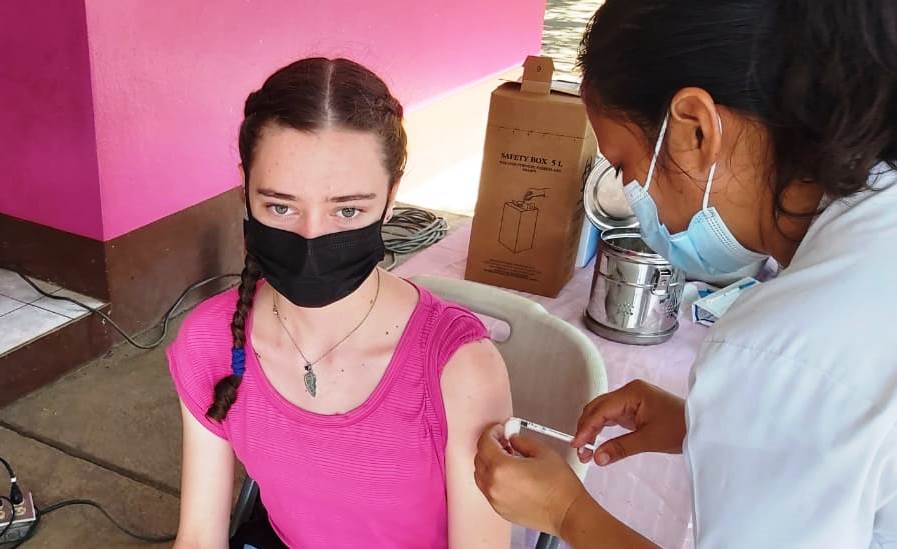
The gray light of predawn was just fading when I arrived at the health center with my two daughters, and I was surprised to see we were the first ones there. It was Monday, October 25th, the first day that COVID vaccines for 2 - 29 year olds would be available in Nicaragua, and I had expected there to be a line already. I had recently been vaccinated with the over-30s age group and had stood in line at a hospital with thousands of people for several hours. Our AstraZeneca vaccines were donated through the COVAX program and due to developed countries hoarding vaccines, in Nicaragua it had only been available at major hospitals…until this week.


So where were all the waiting people now? In contrast to the earlier vaccines, the vaccines for 2 - 29 year olds are from Cuba and Russia and were shipped in batches of a million or more doses that don’t require storage in sub-zero temperatures, so the Ministry of Health made them available countrywide at 1,087 health centers simultaneously. My daughters may have been the first to arrive and get the COVID vaccine at our health center that day, but there was a steady stream of children and young people behind them and also at five other health centers in our city.

That first morning, Nicaragua vaccinated 93,438 people. By 7 PM Friday, Nicaragua had applied at least one dose of various donated COVID vaccines to 26% of the target 2 - 29 year-old population, 54% of pregnant women and 62% of over-30s. This is the equivalent of 43% of the total population, the majority of those vaccines applied in the past 6 weeks. This feat is not surprising given Nicaragua’s experience organizing annual vaccination campaigns and its 98% overall vaccination rate, but is still impressive for any country.

Yet, what were the international headlines this week? (If I sound angry here, it’s because I actually really am angry, so bear with me…) “Thousands of Nicaraguans cross border into Honduras to be vaccinated.” Articles claimed that lack of vaccines in Nicaragua was pushing hundreds of Nicaraguans each day to get vaccinated in Honduras.

It is true that Nicaraguans were going to Honduras to be vaccinated – paying hundreds of dollars for taxis and boatmen to take them undocumented across the river, only to have to pay again in a few weeks when they need their second dose – but given the massive success of this week’s vaccinations, it certainly wasn’t due to lack of vaccine in Nicaragua. So why were they risking an illegal crossing to receive Pfizer and Moderna vaccines?


1)      The same Monday that Nicaragua began vaccinating children and young people, the United  States announced that it would no longer allow foreigners to visit the U.S. unless they are vaccinated with U.S.-approved vaccines – which do not include Russian or Cuban-developed vaccines. Anyone with hopes of traveling to the U.S. (and with the resources to do so) zipped up to the border for a U.S.-approved shot.


2)      The Honduran government, undoubtedly acting on orders from the U.S., set aside 100,000 doses of the U.S.-donated Pfizer and Moderna vaccine at immigration posts along the border and announced their intention to vaccinate Nicaraguans, enticing people to make the trek.


3)      A certain population of Nicaraguans has been manipulated into thinking that the Russian and Cuban vaccines are unsafe. Contributing to this is the fact that, although Russia registered Sputnik V as the world’s first COVID-19 vaccine in August 2020, the World Health Organization still hasn’t approved it, and has no clear timeline to do so. This is particularly baffling considering Sputnik V is 91.6% effective – higher than AstraZeneca or J&J. The one-dose Sputnik Light currently being applied in Nicaragua is 70% effective against the Delta variant, 83% effective against infection, 94% effective against hospitalization and can be used as a booster for other vaccines.


Due to the 60 year economic embargo against it, Cuba has a long history of developing its own vaccines and the Soberana 2 and Abdala being applied in Nicaragua are 90% effective against COVID-19; 100% of Cuba’s eligible population has had at least one dose, and by the end of November Cuba expects to have 90% of its population fully vaccinated. In mid-September, Cuba began seeking approval from WHO for its vaccines, but has not yet made headway. All the Russian and Cuban vaccines can be stored in a regular refrigerator, making it more accessible for poorer countries without subzero storage conditions. Given clear evidence of the safety and effectiveness of the Russian and Cuban vaccines, the lack of emergency approval for them is perplexing… unless, of course, it’s politically motivated.


The U.S. manipulation machine is hard at work. Why? This coming Sunday, the 7th of November, Nicaragua is holding general elections…and the U.S. is knee-deep meddling in these elections in an attempt to keep the ruling FSLN party from winning: the U.S. ambassador to Nicaragua has been accused of interference with Nicaragua’s internal democratic process, and the U.S. has been announcing for months that the elections are a “sham.”


So this week’s “vaccine diplomacy” – cruelly manipulating a tragic pandemic for its own political ends – is just the latest in the U.S.’s last-ditch effort to keep Nicaraguans from choosing their own President. Another shameful example of this is that although the U.S. donated COVID vaccines to every other country in Central America months ago, it only donated vaccines to Nicaragua this week, 10 days out from the election.


To say that U.S. vaccine maneuverings are hypocritical is an understatement. Nicaragua’s vaccinations this week far surpass anything the giant to the north has been able to accomplish. In terms of population, Nicaragua’s vaccinations this past Monday morning would be the equivalent of the United States vaccinating 4.7 million people in a few hours. Nicaragua has gone from 8% of the population partially vaccinated to 43% in just six weeks; in comparison, after more than 10 months of plentiful free vaccines, only 66% of the U.S. population is even partially vaccinated, and 0% of its 2-11 year old children are vaccinated. It also bears mentioning that the U.S. has thrown out more than 15 million vaccine doses – enough to vaccinate every Nicaraguan twice – and is offering a third shot while people around the world still clamor for a first dose.


But that doesn’t stop the U.S. from manipulating Nicaraguans into crossing the border for a “better” vaccine.


The good news is that despite U.S. machinations, Nicaragua is proceeding with its vaccination campaign, expecting to have more than half of its target population vaccinated before next Sunday’s elections, and 90% before year’s end. Nicaragua is also the only country in Central America to begin producing COVID-19 vaccine, with doses of Russian COVI-VAC expected to be offered as booster shots to Nicaragua’s population in early 2022 and exports to Latin America to begin later in the year.   


And, despite the U.S.’s best efforts, Nicaraguans will participate in their exemplary democratic process next Sunday. It is expected that at least 75% of those over 16 will vote, about 3.35 million people. By comparison, in the U.S., less than 80% of eligible citizens are even registered to vote, and record voting in 2020 had just 66% of registered voters casting a ballot.


Nicaragua once again shows that it compares favorably to the U.S., both in COVID-19 vaccinations and democracy, earning the giant’s ire by continuing to be the threat of a good example. 

– Becca Mohally Renk, Jubilee House Community 


[English above] 

Apenas estaba amaneciendo cuando llegué al centro de salud con mis dos hijas, y me sorprendió ver que éramos las primeras en llegar. Era el lunes 25 de octubre, el primer día en que las vacunas COVID para niños de dos a 29 años estarían disponibles en Nicaragua, y esperaba que ya hubiera una fila. Recientemente me habían vacunado con el grupo de mayores de 30 años y había hecho fila en un hospital con miles de personas durante varias horas. Nuestras vacunas AstraZeneca fueron donadas a través del programa COVAX y debido a que los países desarrollados acaparan vacunas, en Nicaragua solo habían estado disponibles en los principales hospitales… hasta esta semana.

Entonces, ¿dónde estaban todas las personas que esperaban ahora? A diferencia de las vacunas anteriores, la vacuna para jóvenes de dos a 29 años es de Cuba y Rusia y se envió en lotes de un millón o más de dosis que no requieren almacenamiento en temperaturas bajo cero, por lo que el Ministerio de Salud las hizo disponible en todo el país en 1.087 centros de salud simultáneamente. Mis hijas eran las primeras en llegar y recibir la vacuna COVID en nuestro centro de salud ese día, pero había un flujo constante de niños y jóvenes detrás de ellas y también en los otros cinco centros de salud en nuestra ciudad.

Esa primera mañana del lunes, Nicaragua vacunó a 93,438 personas. A las 7 PM el viernes, Nicaragua había aplicado al menos una dosis de la vacuna COVID al 26% de la población objetivo de dos a 29 años, al 54% de las mujeres embarazadas y al 62% de los mayores de 30 años. Esto equivale al 43% de la población total, la mayoría de las vacunas aplicadas en las últimas 6 semanas. Esta hazaña no es sorprendente dada la experiencia de Nicaragua en la organización de jornadas anuales de vacunación y su tasa general de vacunación del 98%, pero sigue siendo impresionante para cualquier país.

Sin embargo, ¿cuáles fueron los titulares internacionales esta semana? (Si sueno enojado aquí, es porque en realidad estoy enojada, así que tengan paciencia conmigo ...) “Miles de nicaragüenses cruzan la frontera hacia Honduras para vacunarse.” Los artículos afirmaban que una “falta de vacunas” en Nicaragua estaba presionando a cientos de nicaragüenses por día a vacunarse en Honduras.

Es cierto que algunos nicaragüenses iban a vacunarse a Honduras -pagaban cientos de dólares por taxis y barqueros que los llevaran indocumentados al otro lado del río, solo para tener que volver a pagar en pocas semanas cuando necesiten su segunda dosis- pero dado el enorme éxito de las vacunas de esta semana, ciertamente no se debió a la falta de vacunas en Nicaragua. Entonces, ¿por qué se arriesgaban a cruzar ilegalmente las vacunas Pfizer y Moderna?

  1. El mismo lunes que Nicaragua comenzó a vacunar a niños y jóvenes, Estados Unidos anunció que ya no permitiría que los extranjeros visiten Estados Unidos a menos que estén vacunados con vacunas aprobadas por Estados Unidos, que no incluyen vacunas desarrolladas por Rusia o Cuba. Cualquiera con la esperanza de viajar a los EE. UU. (y los recursos para hacerlo) se fue a la frontera para una vacuna aprobada por EE. UU.

  2. El gobierno hondureño, actuando sin duda por órdenes de los EE. UU., reservó 100,000 dosis de la vacuna Pfizer y Moderna donada por los EE. UU. en los puestos de inmigración a lo largo de la frontera y anunció su intención de vacunar a los nicaragüenses, lo que incitó a la gente a hacer el viaje.

  3.  Cierta población de nicaragüenses ha sido manipulada para que piense que las vacunas rusa y cubana no son seguras. A esto contribuye el hecho de que, aunque Rusia registró el Sputnik V como la primera vacuna COVID-19 del mundo en agosto de 2020, la Organización Mundial de la Salud aún no la ha aprobado y no tiene un cronograma claro para hacerlo. Esto es particularmente desconcertante considerando que el Sputnik V tiene una efectividad del 91.6%, más alto que AstraZeneca o J&J. La dosis única de Sputnik Light que se aplica actualmente en Nicaragua es 70% efectiva contra la variante Delta, 83% efectiva contra infecciones, 94% efectiva contra hospitalización y puede usarse como refuerzo para otras vacunas.

    Debido al embargo económico de 60 años en su contra, Cuba tiene una larga historia de desarrollo de sus propias vacunas y la Soberana 2 y Abdala que se están aplicando en Nicaragua son 90% efectivas contra COVID-19; el 100% de la población elegible de Cuba ha recibido al menos una dosis, y para fines de noviembre Cuba espera tener el 90% de su población completamente vacunada. A mediados de septiembre, Cuba comenzó a buscar la aprobación de la OMS para sus vacunas, pero aún no ha avanzado. Todas las vacunas rusas y cubanas se pueden almacenar en un refrigerador normal, lo que lo hace más accesible para los países más pobres sin condiciones de almacenamiento bajo cero. Dada la evidencia clara de la seguridad y eficacia de las vacunas rusa y cubana, no se explica la falta de aprobación de emergencia ... a menos, por supuesto, que sea por motivos políticos.

La máquina de manipulación de Estados Unidos está trabajando duro. ¿Por qué? El próximo domingo 7 de noviembre Nicaragua celebrará elecciones generales ... y EE.UU. esta involucrado hasta las rodillas en estas elecciones en un intento de evitar que gane el partido gobernante FSLN: el embajador de EE.UU. en Nicaragua ha sido acusado de injerencia en la democracia interna de Nicaragua, y Estados Unidos ha estado anunciando durante meses que las elecciones son una "farsa."

Así que la "diplomacia de las vacunas" de esta semana - la manipulacion cruel de una trágica pandemia para sus propios fines políticos - es solo el último esfuerzo de Estados Unidos para evitar que los nicaragüenses elijan a su propio presidente. Otro ejemplo vergonzoso de esto es que, aunque Estados Unidos donó vacunas COVID a todos los demás países de Centroamérica hace meses, solo donó vacunas a Nicaragua esta semana, 10 días antes de las elecciones.

Decir que las maniobras estadounidenses de las vacunas son hipócritas es quedarse corto. Las vacunas de Nicaragua esta semana superan con todo lo que el gigante del norte ha podido lograr. En términos de población, las vacunaciones de Nicaragua el pasado lunes por la mañana equivaldrían a que Estados Unidos vacunara a 4,7 millones de personas en pocas horas. Nicaragua ha pasado del 8% de la población parcialmente vacunada al 43% en solo seis semanas; en comparación, después de más de 10 meses de abundantes vacunas gratuitas, solo el 66% de la población de EE. UU. está parcialmente vacunada, y el 0% de sus niños de 2 a 11 años están vacunados. También vale la pena mencionar que EE. UU. ha descartado más de 15 millones de dosis de vacunas, suficientes para vacunar a cada nicaragüense dos veces, y está ofertando una tercera vacuna, mientras hay mucha gente en el mundo que todavía clama por una primera dosis.

Pero eso no impide que Estados Unidos manipule a los nicaragüenses para que crucen la frontera en busca de una vacuna "mejor."

La buena noticia es que, a pesar de las maquinaciones de Estados Unidos, Nicaragua continúa con su jornada de vacunación, esperando vacunar a más de la mitad de su población objetivo antes de las elecciones del próximo domingo y al 90% antes de fin de año. Nicaragua es también el único país de América Central que comienza a producir la vacuna COVID-19, y se espera ofrecer la vacuna desarrollada en Rusia COVI-VAC a la población de Nicaragua a principios de 2022 y que las exportaciones a América Latina comiencen más adelante en el año.

Y, a pesar de los mejores esfuerzos de Estados Unidos, los nicaragüenses participarán en su ejemplar proceso democrático el próximo domingo. Se espera que voten al menos el 75% de los mayores de 16 años, unos 3,35 millones de personas. En comparación, en los EE. UU., Menos del 80% de los ciudadanos elegibles están incluso registrados para votar, y la votación récord en 2020 tuvo solo el 66% de los votantes registrados emitiendo su voto. 

Nicaragua demuestra una vez más que se compara favorablemente con Estados Unidos, tanto en vacunación COVID-19 como en democracia, ganándose la ira del gigante al seguir siendo la  amenaza de un buen ejemplo.

 - Becca Mohally Renk, Jubilee House Community 

NOTE: If you are reading this blog using the mobile version, click on "web version" to see the full blog with all the features including "subscribe to blog by email".  


Please join us and also share on your social media.

Donate here to the ongoing work of the CDCA with the poor in Nicaragua: