Translate

Showing posts with label poverty. Show all posts

Wednesday, July 27, 2022

Make Them Hear You

 [Español abajo]


Our son Coury’s spring recital included operatic and classical vocal numbers, followed by some musical theater songs. And then he introduced his last set by commenting that the songs in the first two sets were written by people with wealth and power.  His last set was composed of the people’s music and he sang Latin American revolutionary pieces.  His encore was “Make Them Hear You” from Ragtime and tears rolled down my face.

Michael Coury Murdock

As I listened to his rich deep voice, I thought, "I don’t know how you make Them hear you.". Powerful music makes you think.


Justice fighters through the ages struggle with this concept.  Sometimes they pick up arms like many who sang those revolutionary pieces Coury sang.  Sometimes they pick up pens and write poems, books, speeches, and songs pouring out their passion for justice and freedom like Victor Jara or León Gieco.


Sometimes justice fighters are lucky to have a charisma that transcends time like Gandhi and Martin Luther King, Jr., that can motivate people to march, get beaten up and thrown in jail, and keep on.

photo: Casa Benjamin Linder mural of Gandhi

But for me… little old me… I am at a loss.


With our choices, we tried to teach our children the passion for  justice and they sometimes amaze us with their kindness, bravery, and insight.  With our work and lives we tried to teach the CDCA's volunteers the love of justice… but who knows?  Some we are close to and know their concerns for the world; but most, I think, they just went on with their lives.


Try as I might, I do not know how to make Them hear me.


With no volunteers around to try to teach, I write.  I attempt to explain about trying to stand with the poor in Nicaragua… and the vast majority of the poor side with the current Nicaraguan government… and yet, even people who know us accuse us of supporting a “dictator.” 


The world's habitat and creatures of beauty created by the Divine are dying.  The government here prioritizes responding to climate change while SCOTUS strips the EPA of its power, and yet I cannot make others see that if you side with the Divine then you must side with those protecting the creation of the Divine… as Nicaragua does.


But I can't make Them hear me.


THEY are spewing lies, insanity, hatred, and yes, fascism.  Their voices are so loud and so prevalent because THEY have the power and wealth   WE need to lift all our voices. We have to make them hear us. We HAVE to… and I honestly have no idea how.

-Kathleen 


Please join us and also share on your social media.

Donate here to the ongoing work of the CDCA with the poor in Nicaragua:

https://donatenow.networkforgood.org/jhc-cdca 


[English above] 


El recital de primavera de nuestro hijo Coury incluyó números vocales de ópera y clásicos, algunas canciones de teatro musical y presentó su último set comentando que las canciones de los dos primeros sets fueron escritas por gente con riqueza y poder.  Su último set estaba compuesto por música del pueblo y cantó piezas revolucionarias latinoamericanas.  Su bis fue "Make Them Hear You", de Ragtime, y se me saltaron las lágrimas.


Mientras escuchaba su rica y profunda voz, pensé: "No sé cómo hacer que te escuchen". La música poderosa te hace pensar.


Los defensores de la justicia a través de los tiempos luchan con este concepto.  A veces cogen las armas, como muchos de los que cantaron esas piezas revolucionarias que cantaba Coury.  A veces toman el lápiz y escriben poemas, libros, discursos y canciones derramando su pasión por la justicia y la libertad como Víctor Jara o León Gieco.


foto: argentina.gob.ar - León Gieco

A veces los luchadores por la justicia tienen la suerte de tener un carisma que trasciende el tiempo como Gandhi y Martin Luther King, Jr. que puede motivar a la gente a marchar, a recibir golpes y a ir a la cárcel, y a seguir adelante.

foto: mural en la Casa Benjamin Linder

Pero para mí... la pequeña y vieja yo...no tengo idea.


Con nuestras decisiones, intentamos enseñar a nuestros hijos la pasión por la justicia y a veces nos sorprenden con su bondad, su valentía y su perspicacia.  Con nuestro trabajo y nuestras vidas intentamos enseñar a los voluntarios del CDCA, el amor por la justicia... pero ¿quién sabe?  A algunos los tenemos cerca y conocemos sus preocupaciones por el mundo; pero la mayoría, creo, simplemente siguieron con sus vidas.


Por mucho que lo intente, no sé cómo hacer que me escuchen.


Al no haber voluntarios para tratar de enseñar, escribo.  Intento explicar cómo tratar de estar al lado de los pobres en Nicaragua y la inmensa mayoría de los pobres están del lado del actual gobierno nicaragüense... y sin embargo, hay personas - y personas que nos conocen - que nos acusan de apoyar a un “dictador''. 


El hábitat del mundo y las criaturas de belleza creadas por el Divino están muriendo.  El gobierno de aquí prioriza responder al cambio climático mientras el Corte Supremo de los Estados Unidos despoja a la Agencia de Protección Ambiental de su poder y sin embargo no puedo hacer ver a los demás que si te pones del lado del Divino entonces debes ponerte del lado de los que protegen la creación de la Divinidad...como se hace en Nicaragua.


Pero no puedo hacer que Ellos me escuchen.


Ellos están vomitando mentiras, locura, odio, y sí, fascismo.  Sus voces son tan fuertes y prevalecen porque ELLOS tienen el poder y la riqueza que NOSOTROS necesitamos para levantar todas nuestras voces. Tenemos que hacer que nos escuchen. TENEMOS que hacerlo... y sinceramente no tengo ni idea de cómo.

-Kathleen 


Monday, June 13, 2022

Reducing the Digital Divide

[Español abajo]

When we moved to Nicaragua in 1994 almost 30 years ago, we did not have the option of having a phone…at all.  No phone lines came to our part of the then-middle-of-nowhere, and cell phones were just beginning to be a thing.

1995 - Sarah toting laptop to dial-in at Gloria's house

We walked or motorcycled about a half a mile to this dear friend's house to upload and download emails through a dial-in phone modem every day.  When we had to make international calls -  like the time the organic certification board lost our paperwork - we had to pay more than a dollar for every minute Mike had to argue with them…the call was 90 plus minutes long.  When we made local calls like to the obstetrician when I was in labor with Joseph, it meant a trip to the phone…BTW the obstetrician missed the birth.


Becca has been interested in cell phones and internet usage here. She went back in her files and found that the number of internet users in Nicaragua in 2007 was 3.3 people per 100 (UNDP International Human Development Index 2007)


Now in 2022, about 85% of Nicaraguans have access to the Internet.  More than 5.5 million people have access to mobile or fixed internet in the 153 municipalities; of which 152 municipalities have 3G coverage and 149 municipalities have 4G coverage, according to the National Telecommunications Company.


That is a HUGE shift! Of course, much has to do with the way technology has improved as well as phone access. Becca also found another old statistic: in 2007 from the same source, only 38 out of 100 people had access to a telephone.


According to Data Reportal "The number of mobile connections in Nicaragua in January 2021 was equivalent to 118.0% of the total population."  Many people have two phones because there are two main phone companies, and to call between them is expensive; therefore, people have a phone for each company.


2022 Cellphone access at El Porvenir coffee co-op

This increase in better internet has much to do with the government's policy of installing fiber optic cable wherever they install electricity, Minister of Energy and Mines Salvador Mansell told Becca and the members of the Light and Legacy Brigade when they met with him.  He showed them a map of the fiber optic cable around Nicaragua which includes cable buried in the sea all along the Caribbean Coast. He said they knew that no internet company was going to invest in putting fiber optics out in the wilds because it wouldn't be profitable, but since the government considers it a right to have access to quality internet, they are installing it.


Our son Coury laments that we in Nicaragua have better internet than he does in California.  


The Nicaraguan government is making sure that people within Nicaragua have access to all the knowledge and connections that are available on the web.  Internet  connections are free in all the parks and on some buses.  


Most Nicaraguans use What's App so calls and texts are free locally and internationally.  Families can stay in touch.


Remembering no phone 1994 - 1998… Today so far we've received photos from our son and daughter-in-law visiting Glasgow Scotland, a video from our granddaughter in Massachusetts, and comments from New Jersey and California.  I'm old and ever so grateful.

-Kathleen


Please join us and also share on your social media.

Donate here to the ongoing work of the CDCA with the poor in Nicaragua:

https://donatenow.networkforgood.org/jhc-cdca 


[English above]


Cuando nos mudamos a Nicaragua en 1994, hace casi 30 años, no teníamos la opción de tener un teléfono...de ningún tipo.  No llegaban líneas telefónicas no llegaban porque en este entonces donde vivimos er campo y los teléfonos celulares no eran comunes.


Caminábamos o íbamos en moto unos 800 metros hasta la casa de una querida amiga para cargar y descargar correos electrónicos a través de un módem telefónico todos los días.  Cuando teníamos que hacer llamadas internacionales -como la vez que la junta de certificación orgánica perdió nuestros papeles- teníamos que pagar más de un dólar por cada minuto que Mike tenía que discutir con ellos... la llamada duraba más de 90 minutos.  Cuando hacíamos llamadas locales, como al obstetra cuando estaba de parto con Joseph, significaba un viaje al teléfono... Además, el obstetra se perdió el parto.


Becca se ha interesado por los teléfonos móviles y el uso de Internet aquí. Volvió a sus archivos y encontró que el número de usuarios de Internet en Nicaragua en 2007 era de 3,3 personas por cada 100 (Índice de Desarrollo Humano Internacional del PNUD 2007)


Ahora cerca del 85% de los nicaragüenses tienen acceso a Internet.  Más de 5,5 millones de personas tienen acceso a Internet móvil o fijo en los 153 municipios; de los cuales 152 municipios tienen cobertura 3G y 149 municipios tienen cobertura 4G, según la Empresa Nacional de Telecomunicaciones.


¡Es un cambio ENORME! Por supuesto, mucho tiene que ver con la forma en que la tecnología ha mejorado y el acceso al teléfono. También encontró otra vieja estadística: en 2007 de la misma fuente, sólo 38 de cada 100 personas tenían acceso a un teléfono.


Según Data Reportal "El número de conexiones móviles en Nicaragua en enero de 2021 equivalía al 118,0% de la población total."  Muchas personas tienen dos teléfonos porque hay dos compañías telefónicas principales y llamar entre ellas es caro; por lo tanto, la gente tiene un teléfono para cada compañía.


Voluntaria compartiendo fotos de móvil en Nueva Vida


Este aumento de la mejora de Internet tiene mucho que ver con la política del gobierno de instalar cable de fibra óptica dondequiera que se instale electricidad, dijo el Ministro de Energía y Minas Salvador Mansell a Becca y a los miembros de la Brigada de Luz y Legado cuando se reunieron con él.  Les mostró un mapa del cableado de fibra óptica alrededor de Nicaragua, que incluye cables enterrados en el mar a lo largo de toda la costa del Caribe. Dijo que sabían que ninguna empresa de internet iba a invertir en poner fibra óptica en areas muy rurales porque no sería rentable, pero como el gobierno considera que es un derecho tener acceso a internet de calidad, lo están instalando.


Nuestro hijo Coury se lamenta de que en Nicaragua tengamos mejor internet que él en California.  


El gobierno nicaragüense se está asegurando de que la gente dentro de Nicaragua tenga acceso a todo el conocimiento y las conexiones que hay en la red.  Las conexiones a Internet son gratuitas en todos los parques y en algunos autobuses.  


La mayoría de los nicaragüenses utilizan What's App, por lo que las llamadas y los mensajes de texto son gratuitos a nivel local e internacional.  Las familias pueden mantenerse en contacto.


De no tener teléfono en 1994 - 1998, hoy mismo a esta hora ya hemos recibido fotos de nuestro hijo y nuestra nuera de visita en Glasgow, Escocia, un video de nuestra nieta en Massachusetts, y comentarios de Nueva Jersey y California.  Estoy vieja y siempre muy agradecida

.- Kathleen


Friday, May 27, 2022

A Day Sexing Fish

It all began with a rural community's need for water. Really?

Well, actually, yes.


You see, many years ago, the communities of Cuajachillo and Trinidad were spending their meager resources and their days hauling water. Could we help? 


hauling oxcarts of water daily

A Rotary Club, Santa Barbara Sunrise, agreed to partner with us and our local Ciudad Sandino Rotary Club, and many years and a lot of effort later, funding came through.


The water department and the city joined in, and with thousands of volunteer hours and 13+ miles of tubing laid by hand, 576 homes now proudly own one ½" water faucet each. Can you imagine 3,000 people being able to finally wash their hands at home?  Scrub their laundry? Cook and clean?


Wonderful!


Water!

Ah, you say, but what has that got to do with sexing fish?


Well, access to water led to the possibility of developing the economic and nutritional benefits of aquaponic systems. Huh?


Yep. Back to the fundraising drawing board, and again through Rotary, a pilot test project was funded, and now stage two, with 40 backyard systems, is happening.


So Saturday, I drove a vehicle up through bouncing ruts pretending to be called roads, gathering participants to join the agrarian engineer for one of his training days. 


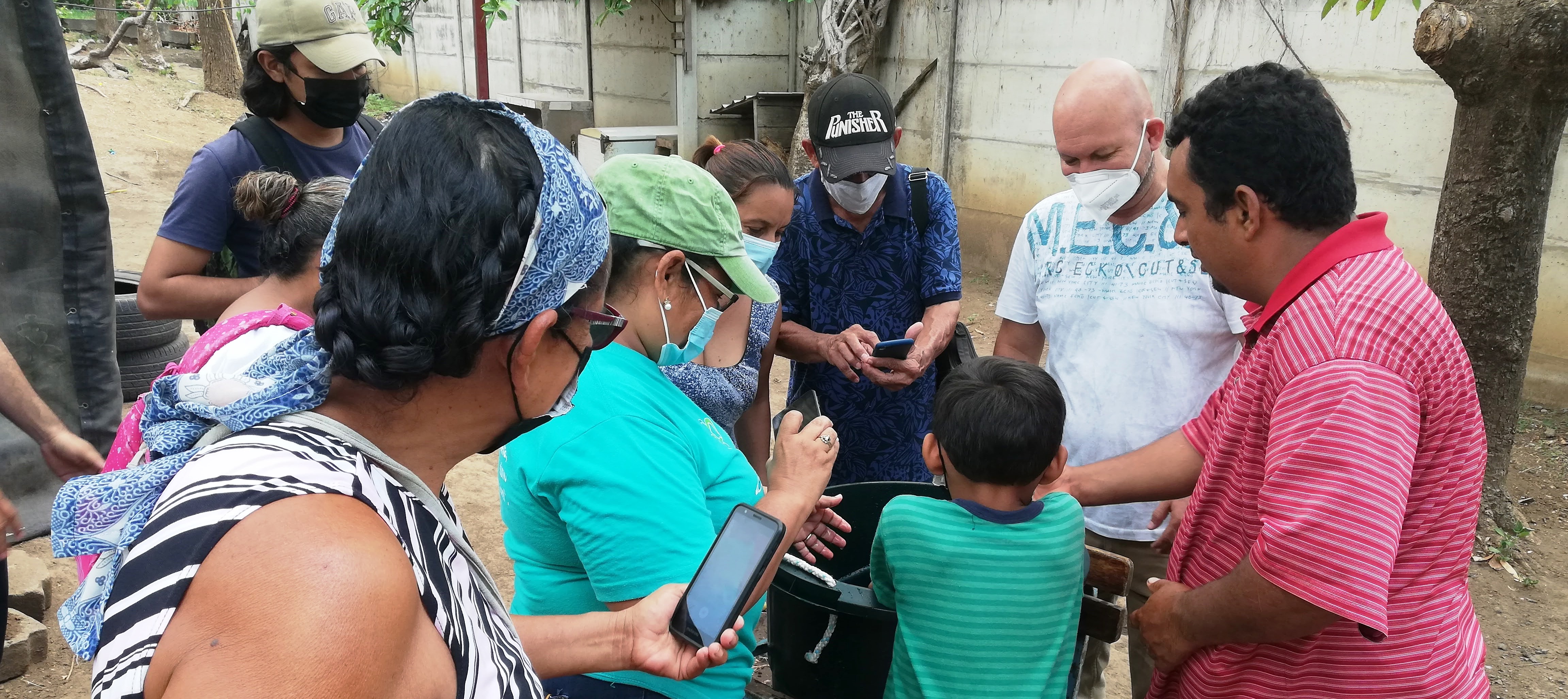
participating in aquaponics training session


We visited six sites. Most were tucked beside tiny homes.


aquaponics system beside tiny rural home


One was a larger one from the pilot project located at a school. Children attending that school had already enjoyed a nutritious fish and vegetable meal from that site, augmenting their free school lunches.


Proud home participants showed off their floating plant beds with thriving insulin, oregano, mint, and other medicinal herbs. Root systems were inspected.


proud system owner demonstrating root health
 

The maturing fish were retrieved, counted, weighed, measured, and yes, sexed… to be able to keep the population male/female ratio thriving and healthy.


carefully retrieving fish for weighing and measuring


These 8-ounce fish will continue to grow until they reach a pound, when they will be harvested and eaten and sold, making room for the smaller ones that are following. And by understanding the reproductive cycle, including the color changes in the male attracting the female, the fertilization process, the role of the female in protecting the eggs for 12 days in her mouth!!!... 12 whole days!!!... before the eggs are ready to hatch into itsy bitsy fish, the participating families learned how to maintain the growth cycle. 


female telapia with tiny eggs in her mouth

Proud? Hot? Excited? Tired? Happy? Yes. The women showing off their systems asked tough questions and problem-solved with the agrarian engineer, chatting over lunch, sharing fish stories and information, heads held high.


lunch and story sharing

And I? I learned to sex fish right along with them.


- Sarah Junkin Woodard


Please join us and also share on your social media.

Donate here to the ongoing work of the CDCA with the poor in Nicaragua:

https://donatenow.networkforgood.org/jhc-cdca 

Tuesday, March 8, 2022

Help Just Around the Corner?

The Nueva Vida Clinic Health Promoter Project went on hold during COVID outbreaks. Now that 86% of Nicaraguans have at least one dose of a COVID vaccine and 64% are fully vaccinated, we have decided to open back up the Health Promoter Project.


What is the Health Promoter Project?


We have 20 promoters in this project. They open their homes to the community around them in order to serve people who need immediate health care…here are some examples:


  • Let’s call the first person in need “Martha”. Martha is feeling woozy and she has hypertension and type 2 diabetes. It's nighttime and going to the hospital is a long 45-minute walk, or if a bus comes by it is a 20-minute ride. Plus, the neighborhood is dangerous after dark. So Martha opts to go to the promoter’s home only a few blocks away. The promoter “Ana” asks her questions, takes her blood pressure, temperature, and tests her blood glucose…all of which Ana has been trained to do by the medical staff in the clinic. These tests will help Ana determine what might be going on. Ana then talks to Martha to help her to figure out if she can wait until morning when our clinic is open, or take the meds that Martha already, has or go straight to the hospital. 
  • Our second person is "Josue"…nine years old and he has suffered from asthma since he was three. It is 2 AM, and he wakes his mom up with his wheezing. She takes him to the promoter in their area, "Miguel", who is trained to triage asthma. He listens and watches Josue after giving him two puffs of a rescue inhaler. Miguel talks to the mother and Josue, trying to create an atmosphere of calm, all the while watching how Josue is breathing. After 10 minutes, Josue is breathing easier and Miguel gives the mom the inhaler and instructs her to take Josue to the clinic in the morning. 
  • Our third person is "Alejandro", who while chopping wood in the early morning with his machete slices his arm as the machete slips. His wife helps him get to "Teresa'' for first aid. Teresa is the promoter on their block and looked after Alejandro’s wife when she was pregnant with their third child. Teresa cleans the wound and pulls the skin together as well as she can with the supplies that our clinic gave her. She wraps it, but tells Alejandro he has to go to the hospital to get stitches, as the wound is too deep and too long for it to heal well on its own. 

  • Our fourth person is "Lisa", who is five years old. She has come home early from kindergarten; her cheek is swollen and she is in tears. “Enrique”, Lisa’s older brothe,brought her home because their mom is at work. Grandma is bed-ridden. Grandma tells Enrique to take Lisa to see his uncle, "Tomas", who is a health promoter. Tomas was trained by dental volunteers as well as by our medical staff. He looks at Lisa and examines her mouth. She has a rotten tooth. The clinic is open and he takes Lisa to our dentist who puts her on an antibiotic and a pain reliever before giving Tomas an appointment for Lisa to return for an extraction.


These are some of the many ways that the health promoters respond from their own homes.


Outside their homes, they keep a pulse on changing community needs, and they let us know what is going on. They help us keep an eye on patients who are at a higher risk than others.


They also do home visits with Elizabeth, our general physician, and Emir, who oversees the Health Promoter Program. Last week, while on their home visits, they found a diabetic patient of ours whose blood glucose was over 500…that is five times what it should have been. She had drunk some milk with a banana blended in it. Elizabeth talked with the woman, treated her to bring down the glucose level, and the promoter then knew to return for another check-up visit on this patient soon.


In their walk-abouts in the Nueva Vida community, another patient was a pregnant mother who it turns out had actually miscarried and was doing poor physically. Elizabeth sent her to the hospital to make sure the uterus was completely expelled. The promoter then knew to follow-up with the grieving mother.


This Health Promoter Program is vital. It is the most cost-effective program that we provide in the clinic. These promoters learn, share their knowledge, open their homes, visit others in their beds, and provide services at night and on the weekends that no one else provides.


Besides monthly classes on various topics, we provide the promoters with first aid kits containing needed supplies and a small stipend each month. The Nueva Vida Clinic expects to see 9,600 patients this year, and the total cost of the Health Promoter Program is $15,380. Will you help?


Sponsor one month’s stipend for a health promoter - $15

Sponsor 20 patients - $25

Sponsor one month of supplies for a first aid kit - $50

Donate now: https://donatenow.networkforgood.org/jhc-cdca


Thank you!
- Kathleen

NOTE: If you are reading this blog using the mobile version, click on "web version" to see the full blog with all the features including "subscribe to blog by email".  
Please join us and also share on your social media.
Website: jhc-cdca.org

Friday, December 31, 2021

Assembly of People Into Giving a Sh*t: May Justice Flow Like a Mighty River

FYI: Assembly of People Into Giving a Sh*t (PIGS) is what Mike and I will name our church, if we ever start one.  The name will weed out a whole bunch of people that care more about language than action.


[Espanol abajo]


Our holiday card was created by our Sarah, who is a talented artist of the Chinese style of ink painting.


It represents our hope for Justice flowing like a mighty river in 2022.


Justice is often a misunderstood concept.


The Department of Justice in the U.S. deals with laws and regulations mostly created by white, wealthy men which makes the Department of Justice a misnomer.


“I want justice for the death of my child…” mostly means I want the person who killed my child to suffer.  


It is understandable, but not justice…this is vengeance.


There was a case here in Nicaragua about two years ago, where one brother killed the other brother in a fit of rage or jealousy or drugs.  I don’t remember.  What I do remember is that the mother begged the judge to let her remaining child go free so that she could still have one child at home.  Odds were good that the murderer would never murder again and the pleas of the mother moved the judge and he granted her her wish.  That was justice…that was compassion.


Professor of Philosophy at Union Theological Seminary, Dr. Cornel West said, “Justice is what love looks like in public.”


When we work for justice we are putting love first.


How do we love our neighbor?  We make sure they have food, security, a home, health care, and the list goes on….that is justice.


How do we love our enemy?  We make sure they have food, security, a home, health care, and the list goes on…that is justice.


Injustice is what greed and selfishness looks like in public.


When society helps the rich get richer while the poor get poorer….that is injustice.


When we ONLY address our own needs or the needs of our family…that is injustice.


When wealthier nations only provide for the security and welfare of their own to the detriment of other poorer nations…that is injustice.


Injustice or the practice of greed and selfishness will lead to war, slavery, poverty, oppression and annihilation.


Justice or the practice of love in public will lead to peace, wholeness, health for all and the world…or life.


Which would you choose to run like a mighty river in 2022?

- Kathleen 


NOTE: If you are reading this blog using the mobile version, click on "web version" to see the full blog with all the features including "subscribe to blog by email".  

Please join us and also share on your social media.

Donate here to the ongoing work of the CDCA with the poor in Nicaragua:

https://donatenow.networkforgood.org/jhc-cdca 

Ometepe waterfall, Nicaragua - shutterstock licensed photo


PSI: Asamblea de Personas A Quienes Les Importe Un Carajo (PIGS) es lo que Mike y yo llamaremos a nuestra iglesia, si es que alguna vez fundemos una. El nombre eliminará a un montón de personas que se preocupan más por el lenguaje que por la acción.


[English above]


Nuestra tarjeta navideña fue creada por Sarah, quien es nuestra talentosa artista del estilo chino de pintura con tinta.


Representa nuestra esperanza de que la justicia fluya como un poderoso río en 2022.


La justicia es un concepto muchas veces mal entendido.


El Departamento de Justicia en los EEUU se ocupa de las leyes y regulaciones creadas en su mayoría por hombres blancos y ricos, lo que hace que el nombre del Departamento de Justicia sea inapropiado.


“Quiero justicia por la muerte de mi hijo…” principalmente significa que quiero que la persona que mató a mi hijo sufra.


Es comprensible, pero no es justicia… Esto es venganza.


Hubo un caso aquí en Nicaragua hace unos dos años, donde un hermano mató al otro hermano en un ataque de ira, celos o drogas. No recuerdo las circunstancias. Lo que sí recuerdo es que la madre le rogó al juez que dejara libre al hijo que le quedaba para poder tener un hijo en casa. Las probabilidades eran buenas que el asesino nunca volvería a asesinar y las súplicas de la madre conmovieron al juez y le concedió su deseo. Eso fue justicia ... eso fue compasión.


El profesor de Filosofía en el Seminario Teológico Union, Dr. Cornel West dijo: “La justicia es lo que parece el amor en público.”


Cuando trabajamos por la justicia, estamos priorizando el amor.


¿Cómo amamos a nuestro prójimo? Nos aseguramos de que tengan comida, seguridad, un hogar, atención médica, y la lista continúa… eso es justicia.


¿Cómo amamos a nuestro enemigo? Nos aseguramos de que tengan comida, seguridad, un hogar, atención médica, y la lista continúa… eso es justicia.


La injusticia es lo que parece la codicia y el egoísmo en público.


Cuando la sociedad ayuda a los ricos a enriquecerse mientras que los pobres se vuelven más pobres… eso es la injusticia.


Cuando SOLO abordamos nuestras propias necesidades o las necesidades de nuestra familia ... eso es la injusticia.


Cuando las naciones más ricas solo proporcionan la seguridad y el bienestar de los suyos en detrimento de otras naciones más pobres ... eso es la injusticia.


La injusticia o la práctica de la codicia y el egoísmo conducirán a la guerra, la esclavitud, la pobreza, la opresión y la aniquilación.


La justicia o la práctica del amor en público conducirán a la paz, la integridad, la salud para todos y el mundo ... o la vida.


¿Cuál elegirías para fluir como un río caudaloso en 2022?

- Kathleen


Únase a nosotros y también comparta en sus redes sociales.

Done aquí al trabajo continuo de la CDCA con los pobres en Nicaragua:

https://donatenow.networkforgood.org/jhc-cdca 


Saturday, December 11, 2021

Assembly of People Into Giving a Sh*t: Who Causes So Much Joy?

 FYI: Assembly of People Into Giving a Sh*t (PIGS) is what Mike and I will name our church, if we ever start one.  The name will weed out a whole bunch of people that care more about language than action.


[Español Abajo] 


Purisima fireworks 2021 - photo: el19digital.com


¿Quién causa tanta alegría?  Who causes so much joy?


Our banner for the third Sunday of Advent is JOY.


Purisima is the feast day in the Roman Catholic Church’s calendar that celebrates the conception of Mary without sin.  In other words when Mary was conceived in her mother’s womb it was without sin.


Frankly, I have no idea what that actually means…so here is a description as defined by Pope Pius IX in 1854 (Ineffabilis Deus):


It states that Mary, through God’s grace, was conceived free from the stain of original sin through her role as the Mother of God.


In myths from all cultures, conception and birth are frequently a part of the making of gods and goddesses and I do believe that declaring her conception immaculate lifts her up to an almost divine-like state.


Mary is thought of as The Virgin, she is pure and she spends her heavenly time and space to intercede to Jesus/God on behalf of lay people in their prayers.


The celebration of the Immaculate Conception of Mary is exalted and no country celebrates to the extent that Nicaragua does.  It was documented as early as 1742 that in Leon candles were lit for Purisima.


When we first moved here in 1994, Purisima was a much bigger celebration than Christmas.


Nicaraguans (including government ministries, mayoral offices, and all) put up altars to Mary.  There are some lavish ones and some plain ones.  Fireworks are lit all evening long on the 7th of December until midnight.  People go from altar to altar and sing praises about Mary and to Mary in loud voices (Purisima is also called La Gritería…The Shouting).  Those who have the altars then hand out goodies…and depending on the families’ resources or devotion, the goodies are substantial.


Food…rice, beans, cookies, sugar cane, candy, nacatamales, etc.


Toys for the kids.


Plastic buckets, bowls and many household items.


Non-Catholics opt out of the celebration…unless they are poor and need the food, toys, and household items…then they go out and hope they don’t run into their pastor (who also may be participating because they are also poor).


It is a celebration of joy.  The joy of giving to many and the joy of receiving.  The joy of singing together.  The joy of fireworks shooting up into the sky.  The joy that Mary brings to so many Nicaraguans.


Historically most Nicaraguans are poor. To receive gifts this way at the end of the year is a time of plenty for them. Normally the rains have stopped by now.  The harvests are drying in the fields to be collected.  People who work in the formal sector have just received their 13th month of salary as a bonus (and as required by law), so repairs may be made to roofs or painting the outside of the house.  It is their time of having many of their needs fulfilled.


So gratitude to Mary is expected…because Mary is not only Jesus’s mother but the Mother of all.  In many ways…though it would be heresy to propose this…Mary is the goddess of harvests, family, children, suffering, purity and love.  She bore the saviour.  She raised God’s son.  And she watched her boy die on the cross.  She understands the heartaches of mothers.  She understands the need for harvests and food.  She represents love to many…she is a concrete person filled with love willing to hear the prayers of the suffering and pass them on.


With a Church filled with the ordained as only men…Mary fills a vital role to so many of faith.


¿Quién causa tanta alegría?  Who causes so much joy?


- Kathleen 


Please join us and also share on your social media.

Donate here to the ongoing work of the CDCA with the poor in Nicaragua:

https://donatenow.networkforgood.org/jhc-cdca 

Purisima fireworks 2021 - screenshot from live streaming


PSI: Asamblea de Personas A Quienes Les Importe Un Carajo (PIGS) es lo que Mike y yo llamaremos a nuestra iglesia, si es que alguna vez fundemos una. El nombre eliminará a un montón de personas que se preocupan más por el lenguaje que por la acción.


[English above] 


¿Quién causa tanta alegría? 


Nuestro banderín para el tercer domingo de Adviento es ALEGRÍA.


Purísima es la fiesta en el calendario de la Iglesia Católica Romana que celebra la concepción de María sin pecado. En otras palabras, cuando María fue concebida en el vientre de su madre, fue sin pecado.


Francamente, no tengo idea de lo que eso significa realmente ... así que aquí hay una descripción tal como la definió el Papa Pío IX en 1854 (Ineffabilis Deus):


Afirma que María, por la gracia de Dios, fue concebida libre de la mancha del pecado original a través de su papel de Madre de Dios.


En los mitos de todas las culturas, la concepción y el nacimiento son frecuentemente parte de la creación de dioses y diosas y creo que declarar su concepción inmaculada la eleva a un estado casi divino.


María es considerada la Virgen, es pura y pasa su tiempo y espacio celestial para interceder ante Jesús / Dios en nombre de los laicos en sus oraciones.


La celebración de la Inmaculada Concepción de María es exaltada y ningún país celebra tanto como lo hace Nicaragua. Ya en 1742 se documentó que en León prendieron velas para la Purísima.


Cuando nos mudamos aquí en 1994, Purísima era una celebración mucho más grande que la Navidad.


Los nicaragüenses (incluidos los ministerios del gobierno, las alcaldías y todos) ponen altares a María. Los hay lujosos y otros sencillos. Los fuegos artificiales se encienden durante toda la noche del 7 de diciembre hasta la medianoche. La gente va de altar en altar y cantan alabanzas a María y sobre María en voz alta (Purísima también se llama La Gritería). Aquellos que tienen los altares luego reparten regalos... y dependiendo de los recursos o la devoción de las familias, los regalos son sustanciales.


Alimentos ... arroz, frijoles, galletas, caña de azúcar, dulces, nacatamales, etc.


Juguetes para los niños.


Baldes de plástico, panas y muchos artículos para el hogar.


Los evangélicos optan por no participar en la celebración ... a menos que sean pobres y necesitan comida, juguetes y artículos para el hogar ... luego salen y esperan no encontrarse con su pastor (quien también puede estar participando porque también son pobres).


Es una celebración de alegría. La alegría de dar a muchos y la alegría de recibir. La alegría de cantar juntos. La alegría de los fuegos artificiales disparados hacia el cielo. La alegría que María trae a tantos nicaragüenses.


Históricamente, la mayoría de los nicaragüenses son pobres. Recibir regalos de esta manera al final del año es una época de abundancia para ellos. Normalmente las lluvias ya han cesado. Las cosechas se están secando en los campos para ser recolectadas. Las personas que trabajan en el sector formal acaban de recibir su decimotercer mes de salario como aguinaldo (y según lo exige la ley), por lo que se pueden hacer reparaciones en los techos o pintar el exterior de la casa. Es el momento de que se satisfagan muchas de sus necesidades.


Así que se espera gratitud hacia María ... porque María no es solo la madre de Jesús, sino la Madre de todos. En muchos sentidos… aunque sería una herejía proponer esto…María es la diosa de las cosechas, la familia, los hijos, el sufrimiento, la pureza y el amor. Ella dio a luz al Salvador. Ella crió al hijo de Dios. Y vio a su hijo morir crucificado. Ella comprende los dolores de las madres. Ella comprende la necesidad de cosechas y alimentos. Ella representa el amor para muchos…es una persona concreta llena de amor dispuesta a escuchar las oraciones de los que sufren y transmitirlas.


Con una Iglesia de pastores que son únicamente hombres…María cumple un papel vital para muchas personas de fe.


¿Quién causa tanta alegría?

- Kathleen


Únase a nosotros y también comparta en sus redes sociales.

Done aquí al trabajo de la CDCA con comunidades en Nicaragua:

https://donatenow.networkforgood.org/jhc-cdca