Translate

Showing posts with label women. Show all posts

Wednesday, July 6, 2022

Saturday Webinar: Women Facing Hybrid Warfare

[Español abajo]

Here's a great chance to hear first-hand from Nicaraguan women speaking out in the face of mixed and false messaging.  Join us Saturday!


Feeling frustrated? Disenfranchised? Enraged? You’re not alone.
Around the globe, women are disproportionately victimized by hybrid warfare, which blends conventional, irregular and cyberwarfare with fake news and foreign electoral intervention.

What does hybrid warfare feel like when it’s being waged against you? Find out this Saturday when we speak to Nicaraguan women about their experiences of with the violence of 2018 and their efforts to counteract disinformation since then. Our speakers will break down hybrid warfare and how it affects women in Nicaragua and beyond.

Join us! Register here: bit.ly/powerandprotagonism

Featuring:

Camila Escalante - journalist, @KawsachunNews

Ima Alfaro - FEM Nicaragua, President of Las Diosas processing plant
Yorlis Gabriela Luna - Grassroots Educator and Researcher

Andrea Michelle Pérez Espinoza - journalist and academic


Saturday, July 9 - 9 am PDT / 10 am Central America / 11 am CDT / 12 pm EDT / 5 pm UK

[English above]


Mujeres Ante la Guerra Híbrida

¿Se siente frustrada? ¿Desprotegida? ¿Enfurecida? No estás sola. En todo el mundo, las mujeres son víctimas desproporcionadas de la guerra híbrida, que combina la guerra convencional, irregular y cibernética con las noticias falsas y la intervención electoral extranjera.


¿Cómo se siente la guerra híbrida cuando se libra contra ti? Descúbrelo este sábado cuando hablemos con mujeres nicaragüenses sobre sus experiencias con la violencia de 2018 y sus esfuerzos para contrarrestar la desinformación desde entonces. Nuestras ponentes desmenuzarán la guerra híbrida y cómo afecta a las mujeres en Nicaragua y más allá.


¡Únete a nosotros! Inscríbete aquí: bit.ly/powerandprotagonism


Con la participación de:

Camila Escalante - periodista, @KawsachunNews

Ima Alfaro - FEM Nicaragua, Presidenta de la planta procesadora Las Diosas

Yorlis Gabriela Luna - educadora e investigadora de base

Andrea Michelle Pérez Espinoza - periodista y académica


Sábado 9 de julio - 9 am PDT / 10 am Centroamérica / 11 am CDT / 12 pm EDT / 5 pm UK

Friday, May 27, 2022

A Day Sexing Fish

It all began with a rural community's need for water. Really?

Well, actually, yes.


You see, many years ago, the communities of Cuajachillo and Trinidad were spending their meager resources and their days hauling water. Could we help? 


hauling oxcarts of water daily

A Rotary Club, Santa Barbara Sunrise, agreed to partner with us and our local Ciudad Sandino Rotary Club, and many years and a lot of effort later, funding came through.


The water department and the city joined in, and with thousands of volunteer hours and 13+ miles of tubing laid by hand, 576 homes now proudly own one ½" water faucet each. Can you imagine 3,000 people being able to finally wash their hands at home?  Scrub their laundry? Cook and clean?


Wonderful!


Water!

Ah, you say, but what has that got to do with sexing fish?


Well, access to water led to the possibility of developing the economic and nutritional benefits of aquaponic systems. Huh?


Yep. Back to the fundraising drawing board, and again through Rotary, a pilot test project was funded, and now stage two, with 40 backyard systems, is happening.


So Saturday, I drove a vehicle up through bouncing ruts pretending to be called roads, gathering participants to join the agrarian engineer for one of his training days. 


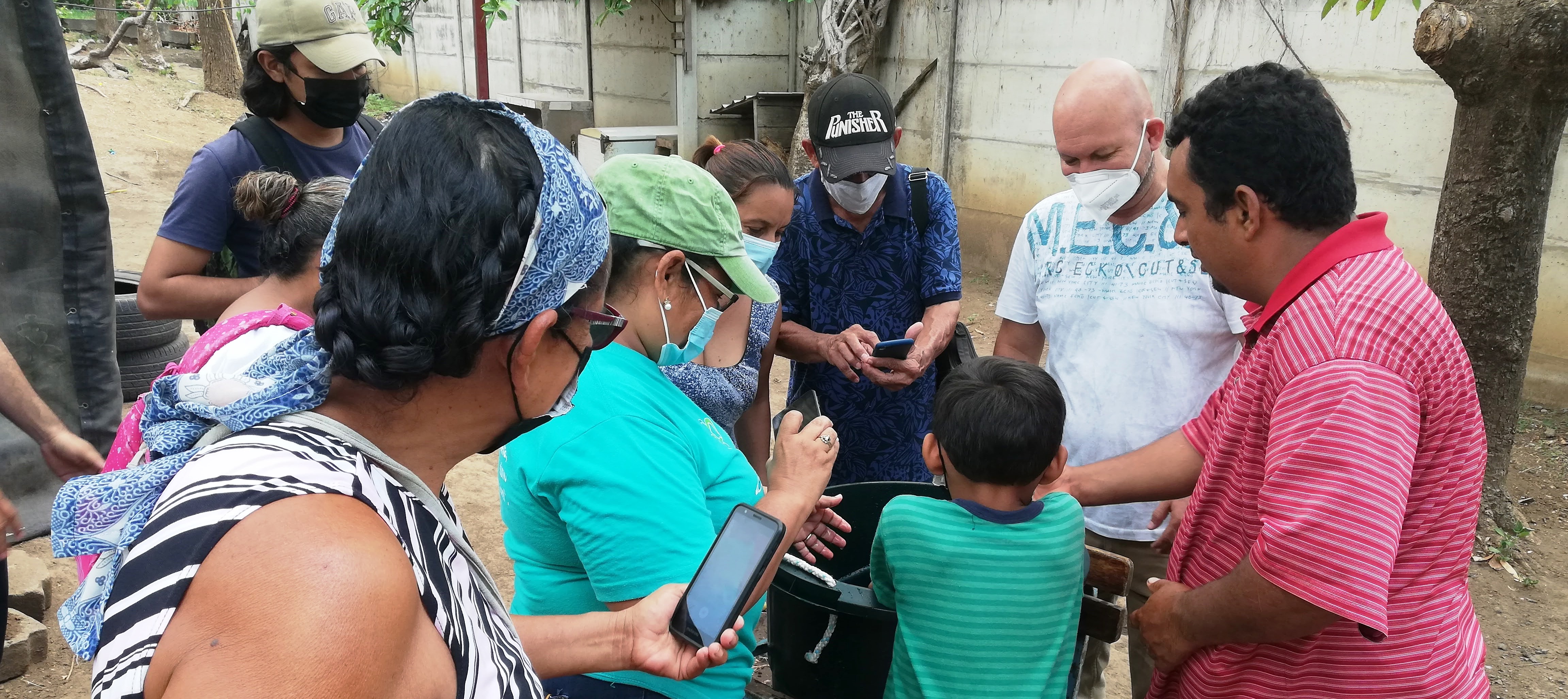
participating in aquaponics training session


We visited six sites. Most were tucked beside tiny homes.


aquaponics system beside tiny rural home


One was a larger one from the pilot project located at a school. Children attending that school had already enjoyed a nutritious fish and vegetable meal from that site, augmenting their free school lunches.


Proud home participants showed off their floating plant beds with thriving insulin, oregano, mint, and other medicinal herbs. Root systems were inspected.


proud system owner demonstrating root health
 

The maturing fish were retrieved, counted, weighed, measured, and yes, sexed… to be able to keep the population male/female ratio thriving and healthy.


carefully retrieving fish for weighing and measuring


These 8-ounce fish will continue to grow until they reach a pound, when they will be harvested and eaten and sold, making room for the smaller ones that are following. And by understanding the reproductive cycle, including the color changes in the male attracting the female, the fertilization process, the role of the female in protecting the eggs for 12 days in her mouth!!!... 12 whole days!!!... before the eggs are ready to hatch into itsy bitsy fish, the participating families learned how to maintain the growth cycle. 


female telapia with tiny eggs in her mouth

Proud? Hot? Excited? Tired? Happy? Yes. The women showing off their systems asked tough questions and problem-solved with the agrarian engineer, chatting over lunch, sharing fish stories and information, heads held high.


lunch and story sharing

And I? I learned to sex fish right along with them.


- Sarah Junkin Woodard


Please join us and also share on your social media.

Donate here to the ongoing work of the CDCA with the poor in Nicaragua:

https://donatenow.networkforgood.org/jhc-cdca 

Monday, April 18, 2022

Three Stories, One Community: One Mother To Another

This Mother's Day, give the gift of healthy moms and babies! Donate to our New Mothers Program in your mom's honor, to see pregnant women safely through to birth and also the first year of their baby's life. To give you an idea of how this vital program is helping women, Emir Fonseca, social worker and the Health Promoter Coordinator for the Nueva Vida Clinic, has shared the stories of Katherine, Solange and Sara* with you.


The Nueva Vida Clinic runs programs that benefit mothers, babies, and children of all ages. Together with the community we are helping to raise healthy children and we are proud to be bringing this contribution to Nueva Vida. We have the privilege to work with brave families with incredible stories of perseverance.

Katherine is a 28-year old patient from the Nueva Vida neighborhood. Last year she came to the clinic very worried because she suspected she was pregnant. The test came back positive, and Katherine was upset because it was not something she had expected. 

After the test result, we talked to Katherine and enrolled her in the New Mothers Program and gave her counseling to help her during her new pregnancy.

Katherine did all of her prenatal care at the clinic and today the baby is 6 months old. She says the program has been instrumental in helping her and she is thankful for the free consultations, medications, educational talks and lab tests.

“I was terrified when I became pregnant, financially I was in bad shape and I did not feel capable of having a baby. Today I thank God and the Clinic for the support they have given me since my pregnancy. The child that I once doubted I wanted is now the joy of our home, he has changed all of our lives. He is a healthy and strong child.”

Another inspiring story is that of Solange, who at 14 years old became pregnant; the father was also a teen. Her family is dysfunctional, she does not have much support from them, and throughout her pregnancy she was part of the New Mothers Program. Because of her young age, she also received psychological counseling.

Unfortunately, Solange’s baby was born two months premature and the newborn spent more than a month in the hospital in an incubator. As a result, the young mother suffered from anxiety and depression, which our psychologist Dr. Dominga treated.

Since the baby was discharged from the hospital, we have been taking care of her through our New Mothers Program. Over the past three months, the improvements in the baby's health are impressive; she is growing rapidly and every day she has fewer health complications. In addition, Solange has overcome her emotional problems with the notable positive change in her daughter.

Solange, in the New Mothers Program, leans through monthly educational talks, we provide the baby with all the medication she needs, lab tests, and we are monitoring her development.

There are many young mothers like Solange's case at the clinic: teen pregnancy remains one of the biggest public health problems in this community. 

Finally, I would like to talk about Sara, she is the mother of an 8 month old baby girl. The girl was born with multiple disabilities including facial malformation and vision problems.  

One day while we were making house calls, Sara called us from the door of her house. We approached and she whispered to us about her daughter, who was sleeping in her crib near the door. Sara explained her disabilities and the economic problems their family has.

Since then, we have been attending Sara and the baby in our clinic in the New Mothers program. It is incredible to see how the mother, in spite of the malformation in her baby’s face, takes the child with discipline and love to her medical appointments and to the educational talks. 

As a social worker, there are situations that affect me, and the case of this baby patient is one of them. She is a super intelligent and sensitive girl who reacts quickly to environmental stimuli, despite her vision problems.

- Emir Fonseca

*Patients' names have been changed.


Este Día de la Madre, ¡regala mamás y bebés sanos! Dona en honor de tu mamá a nuestro Programa de Nuevas Madres para atender a las mujeres embarazadas con seguridad desde la gestación, el nacimiento y el primer año de vida de su bebé. Para darle una idea de cómo este programa vital está ayudando a las mujeres, Emir Fonseca, trabajador social y el Coordinador del Programa de Promotores de Salud de la Clínica Nueva Vida, ha compartido las historias de Katherine, Solange y Sara* con ustedes. La Clínica Nueva Vida lleva a cabo programas que benefician a madres, bebés y niños de todas las edades. Junto con la comunidad estamos ayudando a criar niños sanos y estamos orgullosos de llevar esta contribución a Nueva Vida. Tenemos el privilegio de trabajar con familias valientes con increíbles historias de perseverancia. Katherine es una paciente de 28 años del barrio de Nueva Vida. El año pasado vino a la clínica muy preocupada porque sospechaba que estaba embarazada. El resultado de la prueba fue positivo, y Katherine se sintió muy triste porque no era algo que esperaba. Tras el resultado de la prueba, hablamos con Katherine y la inscribimos en el Programa de Embarazadas y le dimos asesoramiento para ayudarla durante su nuevo embarazo. Katherine realizó todos sus cuidados prenatales en la clínica y hoy el bebé tiene 6 meses y actualmente forma parte del Programa de Lactancia Materna. Dice que los programas han sido fundamentales para ayudarla y agradece las consultas gratuitas, los medicamentos, las charlas educativas y las pruebas de laboratorio. “Me sentí aterrada cuando Salí embarazada, económicamente estaba mal y no me sentía en la capacidad de llevar con éxito mi embarazo, hoy agradezco a Dios y a la Clínica por el apoyo que me brindan desde mi embarazo. El niño que un día dude quererlo tener actualmente es la alegría de nuestro hogar, nos ha cambiado la vida a todos. Es un niño sano y fuerte”. Otra historia inspiradora es la de Solange, que a los 14 años se quedó embarazada; el padre también era un adolescente. Su familia es disfuncional, no tiene mucho apoyo de ellos, y a lo largo de su embarazo formó parte del programa de Embarazadas. Debido a su corta edad, también recibió además consejería e intervención psicológica. Lamentablemente, el bebé de Solange nació dos meses antes de tiempo y el recién nacido pasó más de un mes en el hospital en una incubadora. Como consecuencia, la joven madre sufrió ansiedad y depresión, que nuestra psicóloga, la Dra. Dominga, trató. Desde que el bebé recibió el alta hospitalaria, nos ocupamos de ella a través de nuestro Programa de Lactancia Materna. En los últimos tres meses, las mejoras en la salud del bebé son impresionantes; está creciendo rápidamente y cada día tiene menos complicaciones de salud. Además, Solange ha superado sus problemas emocionales con el notable cambio positivo de su hija. Estamos dando charlas educativas mensuales a Solange, le proporcionamos al bebé toda la medicación que necesita, pruebas de laboratorio y hacemos un seguimiento de su desarrollo. Hay muchas madres jóvenes como el caso de Solange en la clínica: el embarazo adolescente sigue siendo uno de los mayores problemas de salud pública en esta comunidad. Por último, me gustaría hablar de Sara, que es madre de una niña de 8 meses. La niña nació con múltiples discapacidades, entre ellas una malformación facial y problemas de visión. Un día, mientras hacíamos visitas a casa, Sara nos llamó desde la puerta de su casa. Nos acercamos y ella con su voz entre cortada nos habló de su hija, que dormía en su cuna cerca de la puerta. Sara nos explicó su discapacidad y los problemas económicos que tiene su familia. Desde entonces, atendemos a Sara y al bebé en nuestra clínica del programa de Lactancia Materna. Es increíble ver como la mama, a pesar de la malformación en el rostro, lleva con disciplina y amor a la niña a sus citas de niños sanos y a las charlas educativas. 

Como trabador social hay situaciones que me marcan, y el caso de este paciente bebe es uno de ellos, es una niña súper inteligente sensible que reacciona rápidamente a los estímulos del ambiente, a pesar de sus problemas de visión.a pesar de la malformación en la cara de su bebé, lleva a con disciplina y amor a sus citas médicas y a las charlas educativas.

- Emir Fonseca

*Los nombres de los pacientes han sido cambiados.

NOTE: If you are reading this blog using the mobile version, click on "web version" to see the full blog with all the features including "subscribe to blog by email".  

Please join us and also share on your social media.

Donate here to the ongoing work of the CDCA with the poor in Nicaragua:

https://donatenow.networkforgood.org/jhc-cdca 


Tuesday, March 8, 2022

Help Just Around the Corner?

The Nueva Vida Clinic Health Promoter Project went on hold during COVID outbreaks. Now that 86% of Nicaraguans have at least one dose of a COVID vaccine and 64% are fully vaccinated, we have decided to open back up the Health Promoter Project.


What is the Health Promoter Project?


We have 20 promoters in this project. They open their homes to the community around them in order to serve people who need immediate health care…here are some examples:


  • Let’s call the first person in need “Martha”. Martha is feeling woozy and she has hypertension and type 2 diabetes. It's nighttime and going to the hospital is a long 45-minute walk, or if a bus comes by it is a 20-minute ride. Plus, the neighborhood is dangerous after dark. So Martha opts to go to the promoter’s home only a few blocks away. The promoter “Ana” asks her questions, takes her blood pressure, temperature, and tests her blood glucose…all of which Ana has been trained to do by the medical staff in the clinic. These tests will help Ana determine what might be going on. Ana then talks to Martha to help her to figure out if she can wait until morning when our clinic is open, or take the meds that Martha already, has or go straight to the hospital. 
  • Our second person is "Josue"…nine years old and he has suffered from asthma since he was three. It is 2 AM, and he wakes his mom up with his wheezing. She takes him to the promoter in their area, "Miguel", who is trained to triage asthma. He listens and watches Josue after giving him two puffs of a rescue inhaler. Miguel talks to the mother and Josue, trying to create an atmosphere of calm, all the while watching how Josue is breathing. After 10 minutes, Josue is breathing easier and Miguel gives the mom the inhaler and instructs her to take Josue to the clinic in the morning. 
  • Our third person is "Alejandro", who while chopping wood in the early morning with his machete slices his arm as the machete slips. His wife helps him get to "Teresa'' for first aid. Teresa is the promoter on their block and looked after Alejandro’s wife when she was pregnant with their third child. Teresa cleans the wound and pulls the skin together as well as she can with the supplies that our clinic gave her. She wraps it, but tells Alejandro he has to go to the hospital to get stitches, as the wound is too deep and too long for it to heal well on its own. 

  • Our fourth person is "Lisa", who is five years old. She has come home early from kindergarten; her cheek is swollen and she is in tears. “Enrique”, Lisa’s older brothe,brought her home because their mom is at work. Grandma is bed-ridden. Grandma tells Enrique to take Lisa to see his uncle, "Tomas", who is a health promoter. Tomas was trained by dental volunteers as well as by our medical staff. He looks at Lisa and examines her mouth. She has a rotten tooth. The clinic is open and he takes Lisa to our dentist who puts her on an antibiotic and a pain reliever before giving Tomas an appointment for Lisa to return for an extraction.


These are some of the many ways that the health promoters respond from their own homes.


Outside their homes, they keep a pulse on changing community needs, and they let us know what is going on. They help us keep an eye on patients who are at a higher risk than others.


They also do home visits with Elizabeth, our general physician, and Emir, who oversees the Health Promoter Program. Last week, while on their home visits, they found a diabetic patient of ours whose blood glucose was over 500…that is five times what it should have been. She had drunk some milk with a banana blended in it. Elizabeth talked with the woman, treated her to bring down the glucose level, and the promoter then knew to return for another check-up visit on this patient soon.


In their walk-abouts in the Nueva Vida community, another patient was a pregnant mother who it turns out had actually miscarried and was doing poor physically. Elizabeth sent her to the hospital to make sure the uterus was completely expelled. The promoter then knew to follow-up with the grieving mother.


This Health Promoter Program is vital. It is the most cost-effective program that we provide in the clinic. These promoters learn, share their knowledge, open their homes, visit others in their beds, and provide services at night and on the weekends that no one else provides.


Besides monthly classes on various topics, we provide the promoters with first aid kits containing needed supplies and a small stipend each month. The Nueva Vida Clinic expects to see 9,600 patients this year, and the total cost of the Health Promoter Program is $15,380. Will you help?


Sponsor one month’s stipend for a health promoter - $15

Sponsor 20 patients - $25

Sponsor one month of supplies for a first aid kit - $50

Donate now: https://donatenow.networkforgood.org/jhc-cdca


Thank you!
- Kathleen

NOTE: If you are reading this blog using the mobile version, click on "web version" to see the full blog with all the features including "subscribe to blog by email".  
Please join us and also share on your social media.
Website: jhc-cdca.org

Saturday, December 11, 2021

Assembly of People Into Giving a Sh*t: Who Causes So Much Joy?

 FYI: Assembly of People Into Giving a Sh*t (PIGS) is what Mike and I will name our church, if we ever start one.  The name will weed out a whole bunch of people that care more about language than action.


[Español Abajo] 


Purisima fireworks 2021 - photo: el19digital.com


¿Quién causa tanta alegría?  Who causes so much joy?


Our banner for the third Sunday of Advent is JOY.


Purisima is the feast day in the Roman Catholic Church’s calendar that celebrates the conception of Mary without sin.  In other words when Mary was conceived in her mother’s womb it was without sin.


Frankly, I have no idea what that actually means…so here is a description as defined by Pope Pius IX in 1854 (Ineffabilis Deus):


It states that Mary, through God’s grace, was conceived free from the stain of original sin through her role as the Mother of God.


In myths from all cultures, conception and birth are frequently a part of the making of gods and goddesses and I do believe that declaring her conception immaculate lifts her up to an almost divine-like state.


Mary is thought of as The Virgin, she is pure and she spends her heavenly time and space to intercede to Jesus/God on behalf of lay people in their prayers.


The celebration of the Immaculate Conception of Mary is exalted and no country celebrates to the extent that Nicaragua does.  It was documented as early as 1742 that in Leon candles were lit for Purisima.


When we first moved here in 1994, Purisima was a much bigger celebration than Christmas.


Nicaraguans (including government ministries, mayoral offices, and all) put up altars to Mary.  There are some lavish ones and some plain ones.  Fireworks are lit all evening long on the 7th of December until midnight.  People go from altar to altar and sing praises about Mary and to Mary in loud voices (Purisima is also called La Gritería…The Shouting).  Those who have the altars then hand out goodies…and depending on the families’ resources or devotion, the goodies are substantial.


Food…rice, beans, cookies, sugar cane, candy, nacatamales, etc.


Toys for the kids.


Plastic buckets, bowls and many household items.


Non-Catholics opt out of the celebration…unless they are poor and need the food, toys, and household items…then they go out and hope they don’t run into their pastor (who also may be participating because they are also poor).


It is a celebration of joy.  The joy of giving to many and the joy of receiving.  The joy of singing together.  The joy of fireworks shooting up into the sky.  The joy that Mary brings to so many Nicaraguans.


Historically most Nicaraguans are poor. To receive gifts this way at the end of the year is a time of plenty for them. Normally the rains have stopped by now.  The harvests are drying in the fields to be collected.  People who work in the formal sector have just received their 13th month of salary as a bonus (and as required by law), so repairs may be made to roofs or painting the outside of the house.  It is their time of having many of their needs fulfilled.


So gratitude to Mary is expected…because Mary is not only Jesus’s mother but the Mother of all.  In many ways…though it would be heresy to propose this…Mary is the goddess of harvests, family, children, suffering, purity and love.  She bore the saviour.  She raised God’s son.  And she watched her boy die on the cross.  She understands the heartaches of mothers.  She understands the need for harvests and food.  She represents love to many…she is a concrete person filled with love willing to hear the prayers of the suffering and pass them on.


With a Church filled with the ordained as only men…Mary fills a vital role to so many of faith.


¿Quién causa tanta alegría?  Who causes so much joy?


- Kathleen 


Please join us and also share on your social media.

Donate here to the ongoing work of the CDCA with the poor in Nicaragua:

https://donatenow.networkforgood.org/jhc-cdca 

Purisima fireworks 2021 - screenshot from live streaming


PSI: Asamblea de Personas A Quienes Les Importe Un Carajo (PIGS) es lo que Mike y yo llamaremos a nuestra iglesia, si es que alguna vez fundemos una. El nombre eliminará a un montón de personas que se preocupan más por el lenguaje que por la acción.


[English above] 


¿Quién causa tanta alegría? 


Nuestro banderín para el tercer domingo de Adviento es ALEGRÍA.


Purísima es la fiesta en el calendario de la Iglesia Católica Romana que celebra la concepción de María sin pecado. En otras palabras, cuando María fue concebida en el vientre de su madre, fue sin pecado.


Francamente, no tengo idea de lo que eso significa realmente ... así que aquí hay una descripción tal como la definió el Papa Pío IX en 1854 (Ineffabilis Deus):


Afirma que María, por la gracia de Dios, fue concebida libre de la mancha del pecado original a través de su papel de Madre de Dios.


En los mitos de todas las culturas, la concepción y el nacimiento son frecuentemente parte de la creación de dioses y diosas y creo que declarar su concepción inmaculada la eleva a un estado casi divino.


María es considerada la Virgen, es pura y pasa su tiempo y espacio celestial para interceder ante Jesús / Dios en nombre de los laicos en sus oraciones.


La celebración de la Inmaculada Concepción de María es exaltada y ningún país celebra tanto como lo hace Nicaragua. Ya en 1742 se documentó que en León prendieron velas para la Purísima.


Cuando nos mudamos aquí en 1994, Purísima era una celebración mucho más grande que la Navidad.


Los nicaragüenses (incluidos los ministerios del gobierno, las alcaldías y todos) ponen altares a María. Los hay lujosos y otros sencillos. Los fuegos artificiales se encienden durante toda la noche del 7 de diciembre hasta la medianoche. La gente va de altar en altar y cantan alabanzas a María y sobre María en voz alta (Purísima también se llama La Gritería). Aquellos que tienen los altares luego reparten regalos... y dependiendo de los recursos o la devoción de las familias, los regalos son sustanciales.


Alimentos ... arroz, frijoles, galletas, caña de azúcar, dulces, nacatamales, etc.


Juguetes para los niños.


Baldes de plástico, panas y muchos artículos para el hogar.


Los evangélicos optan por no participar en la celebración ... a menos que sean pobres y necesitan comida, juguetes y artículos para el hogar ... luego salen y esperan no encontrarse con su pastor (quien también puede estar participando porque también son pobres).


Es una celebración de alegría. La alegría de dar a muchos y la alegría de recibir. La alegría de cantar juntos. La alegría de los fuegos artificiales disparados hacia el cielo. La alegría que María trae a tantos nicaragüenses.


Históricamente, la mayoría de los nicaragüenses son pobres. Recibir regalos de esta manera al final del año es una época de abundancia para ellos. Normalmente las lluvias ya han cesado. Las cosechas se están secando en los campos para ser recolectadas. Las personas que trabajan en el sector formal acaban de recibir su decimotercer mes de salario como aguinaldo (y según lo exige la ley), por lo que se pueden hacer reparaciones en los techos o pintar el exterior de la casa. Es el momento de que se satisfagan muchas de sus necesidades.


Así que se espera gratitud hacia María ... porque María no es solo la madre de Jesús, sino la Madre de todos. En muchos sentidos… aunque sería una herejía proponer esto…María es la diosa de las cosechas, la familia, los hijos, el sufrimiento, la pureza y el amor. Ella dio a luz al Salvador. Ella crió al hijo de Dios. Y vio a su hijo morir crucificado. Ella comprende los dolores de las madres. Ella comprende la necesidad de cosechas y alimentos. Ella representa el amor para muchos…es una persona concreta llena de amor dispuesta a escuchar las oraciones de los que sufren y transmitirlas.


Con una Iglesia de pastores que son únicamente hombres…María cumple un papel vital para muchas personas de fe.


¿Quién causa tanta alegría?

- Kathleen


Únase a nosotros y también comparta en sus redes sociales.

Done aquí al trabajo de la CDCA con comunidades en Nicaragua:

https://donatenow.networkforgood.org/jhc-cdca 


Saturday, December 4, 2021

Assembly of PIGS: Peace, Shalom, and Salaam


 [Español abajo]


FYI: Assembly of People Into Giving a Shit (PIGS) is what Mike and I will name our church, if we ever start one.  The name will weed out a whole bunch of people that care more about language than action.


During Advent we light candles, sing, and hang our banners… this second week is PEACE.


Peace, like hope, is elusive.  We think of peace as the cessation of war, but in other languages; such as Hebrew and Arabic, the word for peace means so much more.


Our banner has the Arabic word salaamSalaam means “peace” but it also refers to the action of greeting someone by bowing low the head or body and touching one’s forehead to pay homage.  It is a greeting of respect and reverence.  In other words recognizing the worth of another.


In Islam when people exchange this greeting, it helps them develop a relationship. Salaam helps create a bond of love and kinship.  When we recognize the worth of another it is hard to feel hostility towards the other and they, towards us.


The Hebrew word shalom has a whole host of meanings... peace, yes, but also harmony, wholeness, completeness, prosperity, welfare, and tranquility.  Shalom is the idea of a society living in harmony, prosperity, wholeness and tranquility with each other and the world. It is caring for the welfare of all.  Shalom is a state of completeness.


There can be no peace without salaam and shalom.


How do we BEGIN to create a society…a world of completeness… shalom?  Maybe by starting with salaam with each other… understanding that we are all brothers and sisters… we all deserve to be treated with respect and reverence.  This is impossible to do without empathy.


We must practice empathy.  “Walk a mile in my shoes before you judge me.”


Afghanistan is a baffling place to me.  When the U.S. first went to war in Afghanistan in 2001, I asked our friend, Mark Lester, if he could help me understand the country.  He loaned me the book Taliban and it opened my eyes to the history of violence in that nation and how, for poor Afghans, the Taliban was a God-send.


Watching the Taliban swoop in and take power back with little resistance or blood shed after U.S. troops and allies left Afghanistan was confusing for me… a woman… an educated woman… a woman who likes to wear shorts and swim in a bathing suit.


But when I think about what life might have been like in the poor villages of Afghanistan watching my children go hungry, my children be maimed from IEDs and bombs or even die, struggling to keep my family safe and feeling no control or hope… I understand completely the willingness to put on a burka in order to live in a time of cessation of bullets, bombs, and terror.


It all starts with empathy. When we try to imagine someone’s else’s life, then we can begin to understand their choices.


Empathy  empowers us to do shalom… to develop a world with prosperity for all.  To enable people to live wholly full lives.   To provide health and basic rights for all.


If we did this as individuals, imagine how much better the lives of others would be.


If we did this as NATIONS instead of feeding the industrialized war machines, imagine a world of peace.

- Kathleen


[English above]


Durante el Adviento prendemos velas, cantamos y tendemos nuestros banderines, el de esta segunda semana de Adviento es PAZ.


Como la esperanza, la paz es elusiva. Pensamos en la paz como el cese de la guerra, pero en otros idiomas como el hebreo y el árabe, la palabra “paz” significa mucho más.


Nuestro banderín lleva la palabra árabe “salaam.” Salaam significa “paz,” pero también se refiere a la acción de saludar a alguien inclinando la cabeza o el cuerpo y tocando la frente para rendir homenaje. Es un saludo de respeto y reverencia. En otras palabras, reconocer el valor de otro.


En el Islam, cuando las personas intercambian este saludo, les ayuda a desarrollar una relación. Salaam ayuda a crear un vínculo de amor y parentesco. Cuando reconocemos el valor del otro, es difícil sentir hostilidad hacia el otro y para ellos, hacia nosotros.


La palabra hebrea “shalom” tiene muchos significados: paz, sí, pero también armonía, plenitud, integridad, prosperidad, bienestar y tranquilidad. Shalom es la idea de una sociedad que vive en armonía, prosperidad, plenitud y tranquilidad entre sí y con el mundo. Es cuidar el bienestar de todos. El Shalom es un estado de integridad.


No puede haber paz sin salaam y shalom.


¿Cómo EMPEZAMOS a crear una sociedad ... un mundo de plenitud ... shalom? Tal vez comenzando con el salaam entre nosotros ... entendiendo que todos somos hermanos y hermanas ... todos merecemos ser tratados con respeto y reverencia. Esto es imposible de hacer sin empatía.


Debemos practicar la empatía. “Camine una milla en mis zapatos antes de juzgarme.”


Afganistán es un lugar desconcertante para mí. Cuando Estados Unidos fue a la guerra por primera vez en Afganistán en 2001, le pregunté a nuestro amigo, Mark Lester, si podía ayudarme a comprender el país. Me prestó el libro Talibán y me abrió los ojos a la historia de la violencia en esa nación y cómo, para los afganos pobres, los talibanes eran un regalo de Dios.


Ver a los talibanes entrar y recuperar el poder con poca resistencia ni sangre derramada después de que las tropas estadounidenses y sus aliados abandonaron Afganistán fue confuso para mí ... una mujer ... una mujer educada ... una mujer a la que le gusta usar pantalones cortos y nadar en traje de baño.


Pero cuando pienso en cómo podría haber sido la vida en los pueblos pobres de Afganistán viendo a mis hijos pasar hambre, mis hijos mutilados por artefactos explosivos improvisados ​​y bombas o incluso morir, luchando por mantener a mi familia a salvo y sin sentir control ni esperanza... Entiendo completamente la voluntad de ponerse un burka para vivir en una época de cese de balas, bombas y terror.


Todo comienza con la empatía. Cuando intentamos imaginar la vida de otra persona, podemos comenzar a comprender sus elecciones.


La empatía nos empodera para hacer shalom ... para desarrollar un mundo con prosperidad para todos. Permitir que las personas vivan una vida plena. Brindar salud y derechos básicos para todos.


Si hiciéramos esto como individuos, imagínense cuánto mejores serían las vidas de los demás.


Si hiciéramos esto como NACIONES en lugar de alimentar a las máquinas de guerra industrializadas, imaginen un mundo de paz.

- Kathleen 


NOTE: If you are reading this blog using the mobile version, click on "web version" to see the full blog with all the features including "subscribe to blog by email".  

Please join us and also share on your social media.

Donate here to the ongoing work of the CDCA with the poor in Nicaragua:
https://donatenow.networkforgood.org/jhc-cdca