Translate

Tuesday, December 10, 2019

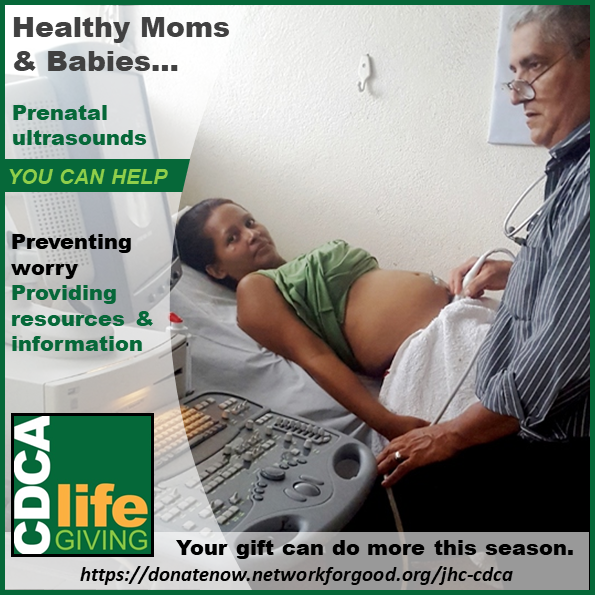
Life Giving: Healthy Moms & Babies


My niece just posted on Facebook a photo of her and her partner holding an ultrasound photo of their new baby.

Ultrasound is a wonderful way to see your new one, but more importantly it is a marvelous tool for doctors.

Physicians can diagnose a high-risk pregnancy and see what is happening in utero with a growing fetus.  They can see blood clots, tumors, kidney stones, gall stones, cysts, and what is happening to organs.

It is a marvelous, safe diagnostic tool that has saved so many lives.

Dr. Jorge Flores is our radiologist and for a year-and-a-half we had no ultrasound machine for him to use because the two that we’d had previously were irreparably broken.  We now have another used one, but we have to order the expensive paper from the United States, and because the machine is worn, Dr. Flores has to manipulate the probes “just right” to get his reading.

However, in spite of the kinks, he shows new mothers their babies.  He reads and gives diagnoses of what he sees to aid our doctors, and for referring physicians to know.  He also sends patients to the hospital when he sees something that needs immediate surgery.  He saves lives.

We are thrilled to be able to offer this service once again, and we hope by the end of 2020 we will have a working x-ray in place, and finished radiology rooms, to expand the Nueva Vida Clinic’s services of diagnostic tools for looking within the human body.

-Kathleen

NOTE: If you are using the mobile version, click on "web version" to see the full blog with all the features including "subscribe to blog by email".  Please join us and also share on your social media.


Saturday, December 7, 2019

Me, Volunteer?... How Can I Possibly Be Helpful?

Greg was a tag-along.

Margaret was our returning medical volunteer, who was busy this week doing valuable home visits, nutrition charlas (education) for folk in Nueva Vida, helping in the pharmacy, offering practical suggestions to help severe diabetics, etc.

She brought Greg along.  He'd seen the photos and heard the stories.

Newly engaged, he came to at least hang out and see what all her interest was about.


We put him to work with Rogelio, Pedro, Lucas, and Wil.


 He learned to sling repello on the wall.


He moved block. 


He vanished with his companeros into the countryside, awe-struck at finding himself inspecting a sesame field, checking on the crop's progress.

His English and their Spanish... a bilingual dance of hands and words, usually producing sufficient communication and a lot of laughter.

Greg came in from work daily, appreciating ever more the range of knowledge, experience, and the personalities of his mentors.  And he paid attention. 

Mid-week Greg came to me... "Would it be possible for me, as an A/C professional, to clean the condenser coils on the clinic A/C and help it run more efficiently and prolong its life?"

He didn't want to step on any toes.  He was being culturally sensitive of those from whom he'd been learning.

"Yes!",  was our enthusiastic response, and "let's bring in Rogelio also."

"Yes!"  was Rogelio's response... "and what tools do you need and how can we help?  What can you teach us for future more effective maintenance?"

And so the next day found Greg climbing the roofs, being tossed one end of a garden hose, to flush out A/C condenser coils.


And crawling around offices, sharing his knowledge with Pedro.


And then... but... hmmm... "Do you also know electrical system information, Greg?

And so off he went on a shopping spree with Rogelio, to purchase the needed voltage tester... and his final workday at the clinic found him partnering with Rogelio to test and record the amperage draw of the clinic air-conditioners... that keep the lab cool enough for its equipment to function... that keep the dental chairs and compressors running... that keep the ultrasound working... and the office computers keeping records... as well as the A/C to maintain the medicine stock.


Why test and record?

Because our tired generator doesn't produce enough umpf (the technical term, of course) to keep everything at the clinic running during the electrical company's frequent power outages, and knowing how much each piece of the puzzle consumes will let us know what we can and can not keep running during each outage, and what capacity we need to look for in a future generator (hint), or with hopeful thinking, a solar system in place (big enormous hint).

What a gift Greg has given us.  

Not a tag-along at all.

As Rogelio said, "We need everybody.  Everybody can help."


Thanks, Greg (and Margaret!)
- Sarah


For More Life-Giving information:  https://jhc-cdca.org/life-giving-2019/

Thursday, December 5, 2019

Future Fridays: Organics... Catch 22?


As Mike and I wrap up our time with the family in California, we find that we have spent a good bit of time going to the grocery store to get milk and eggs.  The closest store to Coury and Cassie carries lots of organic food including Once Again Nut Butter products. The grandsons love their peanut butter.


photo: https://laura-jabri.wixsite.com/
Organics is better for the environment as well as for our bodies.  I think we can all agree on that.  The problem is that organics cost so much more than conventional crops.  Why is that?

Most poor farmers farm organically because they cannot afford the cost of chemical pesticides and fertilizers.  Even though subsistence farmers in poor nations do farm organically, they cannot get the added price for their organic crops that large organic farmers get, due to the fact that the process to become organically certified is expensive.

Certified organic food products cost more in stores.  Certified organic farm products in turn bring in more capital for the growers.


It is a Catch 22:

  • Only large farmers can afford the certification costs and yet, small farmers mostly grow organically.  
  • Customers want certification to prove that the crops are organic and yet, large agri-businesses have - of course - figured out how to scam the system.


testing organic sesame
How do small farmers in Nicaragua get certification?  By banding together to form a large cooperative* that can afford the certification costs.

The farmers who are part of the organic agriculture cooperative, COPROEXNIC, depend on buyers with a conscience, who in turn depend on customers with a conscience who are willing to research businesses and then support those who genuinely buy organic.

And, because organics cost more, the poor are only able to afford food products that are not organic… as always, the poor are left between a rock and a hard place.

-Kathleen

*COPROEXNIC is such a cooperative of small farmers, who banded together more than 20 years ago to obtain organic certification for sesame, peanuts, and coffee. They live and work with the daily challenges of economics and weather.  You can help.

Monday, December 2, 2019

#GivingTuesday: A Health Care Support System is... Within Our Reach

For the past week or so, I have been writing blogs about what goes on in our clinic in preparation for  
#Giving Tuesday…today. 

Our Goal: to raise $5,000 to help the Clinic meet its financial responsibilities
for 2019 and into 2020.


The permanent health clinic in Nueva Vida* celebrates its 20th anniversary this year!  
The clinic has grown and developed over those 20 years and so has its budget.  The budget for the clinic this year is $261.634.00 which is about $720/day.

THIS IS WHAT $720 A DAY PAYS FOR…
  • Acute medical care with one full-time physician (Dr. Flores) and one half-time physician (Dr. Lopez)
  • Medical care for patients with chronic conditions like diabetes, hypertension, etc.  with the above- mentioned doctors.
  • Pediatric care with a part-time pediatrician
  • Ultrasounds with Dr. Flores
  • Restorative dental care with Dr. Escobar
  • Preventive dental care with a hygienist and Dr. Escobar
  • Dental care for children in 20 plus feeding centers throughout Nicaragua
  • Testing outside the laboratory (such as for PAPs and biopsies) in addition to tests done inside the clinic but done by the nurse – for glucose, pregnancy, urine strips and rapid HIV tests (when available)
  • Pharmacy for the medications that the doctors prescribe
  • Therapy three mornings a week with Dr. Soto
  • EKGs
  • Limited gynecological care with Drs. Flores and Lopez and our nurse
  • Prenatal check-ups with Drs. Flores and Lopez
  • Home visits with patients at risk with Dr. Lopez and our 35 lay health promoters
  • First aid and limited other care provided by our lay health promoters from their own homes on weekends and during the night
  • Walk-in wound care
  • Weekly classes for patients with chronic conditions provided by our paid health promoter, Jessenia
  • Bi-monthly classes for pregnant moms and new mothers
  • Monthly classes for our lay health promoters
  • Weekly support groups for pre-teen and teen girls
  • Weekly support groups for boys
  • Limited support for HIV positive patients and their families
  • Aid for patients to get birth certificates and national ID
  • Wheelchairs, crutches, walkers, beds, etc.
  • A current clinic staff of three doctors, one dentist, one nurse, one pharmacist, one lay technician, one hygienist, one health promoter, and a support staff of seven


Please help us meet our goal of $5,000… think how much good your gift will do this #GivingTuesday.
-Kathleen

*Nueva Vida is the neighborhood of Ciudad Sandino, Nicaragua, formed 20+ years ago after Hurricane Mitch.  The Nueva Vida Clinic serves its 12,000 residents as well as any residents from other neighborhoods of the city, population 180,000.

** Abortion is not one of them.  Abortion is illegal in Nicaragua.

NOTE: If you are using the mobile version, click on "web version" to see the full blog with all the features including "subscribe to blog by email".  Please join us and also share on your social media.


Sunday, December 1, 2019

#Giving Tuesday: Happy Bellies are... Within Our Reach

This #GivingTuesday, Happy Bellies are... Within Our Reach.


Alaska has some mighty fine folks who have brought medical brigades to Nicaragua for 15 years now.  And despite the recent high travel advisories they still come, including the most recent group who came the week of November 9-16.

Their very first group that came brought two pediatricians.  Mary was one of them and we had a conversation that went like this:

Me: “You will see lots of parasites in the children.”

Mary: “How will we know what kind of parasites the children have?  Do you have a lab?”

Me: “No.  You will have to guess.  If the feces are frothy treat for giardia.  If there are worms in the feces then treat for that.  If there is a fever then treat for a bacterial infection.  If you are not sure then treat for bacteria and amoebas.”

Mary: “But how will I know?”

Me: “You won’t.  Ask the parents and give it your best shot.”

It took me awhile to calm her fears until the other pediatrician - a retired Air Force pediatrician - finally said, “Mary, no one is going to sue you.  Do your best.”


NOW we have a laboratory with a licensed lab technician.

Much of what the doctors have done in the past was to over-treat making sure they hit all the bases with infections, bacteria, and parasites.  We gave children a dose of Albendazole every six months, to kill what parasites might be their digestive systems, in order to give the children a chance to absorb what food they did eat instead of feeding the little buggies.

NOW with our lab, our doctors can selectively target what is making the patients sick.  Much, much better for the patients.

-Kathleen


NOTE: If you are using the mobile version, click on "web version" to see the full blog with all the features including "subscribe to blog by email".  Please join us and also share on your social media.