[Español Abajo]
“That’s unbelievable,” my father-in-law wrote
me from Ireland after watching me give a statistic-heavy webinar on the
advances for the poor in Nicaragua since 2007.
“I know, right?” I
replied.
“No, I mean it’s
actually unbelievable,” he wrote back. “For cynical and tired privileged people
like ourselves, our faith in humanity has been undermined and we’ve lost all
hope of goodness. The story of a government really looking after ordinary
people is too good to be true.”
I understand what he
means. If I hadn’t been living in Nicaragua for the last 20 years and hadn’t
seen with my own eyes the changes since the Sandinista government came back in
to power with a pro poor strategy 14 years ago, I know that I, too, would dismiss
the statistics as nothing but propaganda.
But I have seen these changes, so how can I
reach those who are too cynical to believe in a government working for the good
of its people?
My father-in-law has been
to our home in a rural village just outside Managua many times over the past 20
years, but it’s been awhile since he visited. His favorite pastime in Nicaragua
has been sitting on our porch, chatting with our neighbors and taking part in
village life. Perhaps if he understood how the statistics translate into real
changes for these villagers he cares for, then he might allow himself to
believe that it’s not just propaganda. So here is a letter to him:
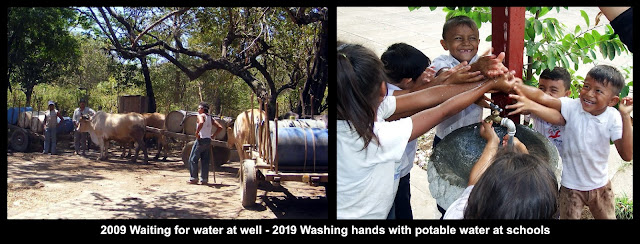
Potable Water: Today, access to potable water in Nicaragua has risen from 65% of urban
homes in 2007 to 92%. Access to water in rural areas has risen from 28% to 55%
and 3,127 community water committees have been established.
Do you remember the
afternoon you spent walking down to the village well with our neighbor Oscar,
waiting in line with all the village boys to fill three barrels of water for
our household, then riding on the ox cart back up the hill? It was a unique
thrill for you, but it was an ordinary afternoon for Oscar. At that time, our
whole village rationed water for washing, bathing and drinking. Our neighbors
only had chickens and a few cows because they had to carry all the water for
livestock. No one had much of a garden, it was too expensive – we and our
neighbors often paid $55 per month for water and hauling it from the well.
Now, a new well
provides water for two villages – 575 households – and we have clean drinking
water coming out of the tap in our homes. The water project is administered by
a community water and sanitation committee which has installed meters and
collects monthly charges – usually less than $10. Our neighbors have more cows,
pigs, and most grow seasonal kitchen gardens – getting starts and seeds for
free from a government program – in addition to their fields of beans, corn and
rice. The boys of the village – the ones who used to spend all afternoon down
at the well – can now do their homework instead…much to their chagrin!
Electrical Coverage: Electrical coverage
has gone from 54% to 99%. In 2007, Nicaragua’s electricity was sourced at only
26% renewable. Today with huge investment in wind, biomass, geothermal, solar,
and hydroelectric, more than 80% of Nicaragua’s electricity is produced using
renewable resources. Since 2007, 38 million barrels of oil have been saved,
thanks to this switch.
Do you remember when you first came to
visit us and you tried to show us a video, but every time the refrigerator motor
kicked in, the computer turned off? Like all our neighbors, we were bringing
our electricity from the well, and even though we had purchased proper wire, at
a distance of 900 meters, the electricity wasn’t stable. You probably remember visiting Mario’s house,
which was barely lit by one bulb at night by electricity conducted through pieced-together
barbed wire.
Well, now every house
in the village is connected to the grid. Each family pays their monthly electric
bill, although those with low consumption – 80% of the population – receive a
subsidy to cover 45% of their bill. Now Mario doesn’t just have one light bulb,
he and his wife Sara have one of the largest shops in the village, with two
refrigerators for selling perishable food and drink.
Education: In 2003, the average Nicaraguan had 3½ years
of schooling and only 30% of those
starting 1st grade were expected to finish 6th grade. Today, youth with no
schooling at all has dropped from 24% to 4%. Rates for passing primary and
secondary grades have increased from 79% to 91% and remarkably, the percentage
of the population with a university degree has risen from 9% to 19%.
Do you remember when
our daughters started preschool at the village primary school when they were
two and three? Remember how their teacher earned less than $20 per month?
Remember how they started the food program, and all the children would line up
with their bowls and spoons to be served beans and rice at recess? Remember when
our younger daughter started first grade and you were so shocked to see a 13
year old in her class who had never learned to read and write?
Do you remember Armando
and Junior who used to come up and juggle on our porch? When their older
cousins finished sixth grade, there wasn’t a secondary school in the village so
students had to travel out to the highway. It wasn’t far, but families couldn’t
afford the transport costs, and so many kids never even made it to 7th
grade. Well, by the time Armando and Junior finished sixth grade, the
government had started a program using rural primary schools for secondary
classes on Saturdays. Kids from surrounding villages now come to our school
here for secondary classes every Saturday. Armando was able to help his grandpa
with their cattle during the week, and Junior got a job in Managua, and on
Saturdays they attended school. Both Armando and Junior graduated last year. They
didn’t go on to university, but they are both now studying at a technical
school – culinary arts and hotel management. Their classmates are in auto
mechanics courses, veterinary school and studying at the university, all for free.
Our village now has agronomists, doctors, nurses, accountants, pharmacists, and
engineers.
Health Care: Since 2007 there are 212% more maternal wait
homes and 88% fewer home births, maternal mortality rates lowered by 70% and
infant mortality rates lowered by 61%. There has been a 46% reduction chronic malnutrition children under 5 and
a 66% reduction chronic malnutrition in children 6 to 12 years old.
Remember when our girls
were born at home? We were lucky enough to pay a doctor to be there with us.
Many of our neighbors had given birth at home too – with no doctor. I remember
talking with a co-worker who told me how she birthed all but one of her
thirteen kids at home by herself! When I was pregnant with Orla, our neighbor
Nelson stopped me on my way to work and asked, “Are you in a hurry?” It turned
out his wife was in labor and needed a ride to the hospital, I was worried
because she was silent during the 30 minute trip – she gave birth just 10
minutes after I dropped them off! Now, our pregnant neighbors don’t have to
worry about traveling in labor, they can go in to the maternal wait home for
the last two weeks of their pregnancies where they are monitored by doctors.
Their moms or sisters can be with them during labor, and they give can give
birth closer to home.
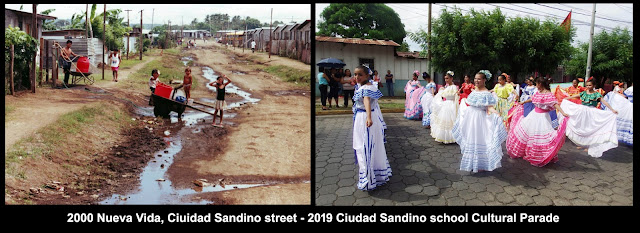
Do you remember on
your first trip to Nicaragua 20 years ago when we drove into the barrio of Nueva
Vida and you remarked at how cute the blond kids were with their fat bellies and
I had to tell you that straw-like hair and potbellies are symptoms of severe
malnutrition? You were heartbroken. Thanks to increased medical care – more medical
professionals, hospitals, health centers, mobile clinics – and the school lunch
program, it’s rare to see kids with visible malnutrition anymore.
Infrastructure: Nicaragua now boasts the best roads in the
region. Since 2007 the country has doubled the mileage of paved roads, paving
new nearly 2,000 KM, repairing another 2,000 KM, building 120 km new bridges
and drainage systems.
Do you remember when
we first moved to the village and you would call us on your land line once a
month and we always had a new story about getting stuck in the mud and pulling
the truck out with three teams of oxen, or the road washing away and having to
walk in and out, or the tires going flat constantly from debris carried into
the road? How long has it been since we had a new story like that for you?
Even following two
Category 4 hurricanes in two weeks last year, the roads were fixed in a matter
of days. Now we have bridges over every arroyo between our house and town, many
of the roads are paved, and the dirt roads are maintained regularly. Even when
it’s raining hard, we can get to work and home again safely, our neighbors get
their crops to town, and the buses and motorcycle taxis run their full routes
year round.
Agriculture: Since 2007, $548 million has been given in
credits to small farmers, attending around 25,700 farmers per year. Since 2007,
nearly 318,000 members have been inducted into 5,900 new cooperatives.
Nicaragua now produces 90% of its own food.
Do you remember our
neighbor Wilmer who used to wave to you as he’d drive his horse cart loaded
with tree trunks? He was feeding his family then by chopping down trees and
selling them for firewood. Well, I recently saw Wilmer at the mayor’s office.
Like us, he was picking up a donation of hardwood seedlings from the Forestry
Institute. He’s not only reforesting his own land, but he’s also learned
aquaculture and has a fish tank for tilapia, and he takes a load of organic
vegetables to market once a week. He and some other neighbors helped us to get
black sesame seeds for a test plot. The farmer co-op we work with has 220 acres
of organic sesame planted in the village this year, and now another 15 acres of
black sesame. For the third year in a row, they’ll give seasonal work to 80 of
our neighbors – mostly women – during the harvest.
Creative Economy: Since 2007, 23,345 micro and small businesses
have been formalized, meaning those workers are now in the social security
system. 3.5 million women have taken free courses, internships, workshops, and
seminars to strengthen work skills. The government has sponsored 32,552 fairs
and built 144 municipal markets. 3.5 million women have taken free courses,
internships, workshops, and seminars to strengthen work skills. 800,000 women
have received loans at 5% annual interest; an average of $18 million dollars is
loaned per year.
Do you remember Paula?
When you last saw her she was a single mom working cleaning and cooking to
support her son. Paula now works an office job and runs two small businesses on
the side. Both businesses are legally registered, and her two employees are
registered with social security, receiving benefits and paying toward their
retirement pensions. Together with a dozen other women, Paula just finished a
free two month-long course on design and product development and is exhibiting
her products at fairs. Her employees attend regular free seminars on customer
service, leadership, and hygiene.
Gender Equality: Since 2006, overall gender equality Nicaragua
has gone from 62 out of 153 countries to number five worldwide. Nicaragua is
number one in the world for women’s health and survival, for women’s
educational attainment and for women cabinet ministers.
One of the things that
have always impressed you about Nicaragua is its people. In particular,
Nicaraguan women come across even to foreigners like you as strong,
independent, and uncompromising. After hearing the tales of our village, and
knowing Nicaraguans as you do, it should not surprise you that Nicaragua is one
of the most gender equal countries in the world, and that in the past 14 years,
it has closed the gender gap by 80%. Nicaraguan women like the ones you know
from our village finally have the legal framework and opportunities to
guarantee them the equality they have always insisted on.
So, after this, are
you still feeling cynical? I know it’s hard to believe that any country has so
intentionally and diligently worked to improve the lot of ordinary people, but
I want you to know that we are witnesses to the exception to the rule that is
Nicaragua.
- Becca Mohally Renk, Jubilee
House Community
NOTE: Names and identifying details of the people mentioned have been
changed.
SOURCES: PLAN NACIONAL DE LUCHA CONTRA LA POBREZA 2022-2026, Gobierno de Nicaragua Junio 2021; World Economic Forum Global Gender Gap Report 2020; United Nations Development Program 2003.
Nicaragua es la Excepción: Carta a un Cínico[Ingles Arriba] "Eso es increíble," me escribió mi
suegro desde Irlanda después de ver un seminario web donde yo di muchas
estadísticas sobre los avances para los pobres en Nicaragua desde 2007.
“¿Verdad
que sí?” Respondí.
“No, quiero
decir que es realmente increíble,” respondió. “Para los privilegiados cínicos y
cansados como nosotros, nuestra fe en la humanidad se ha visto socavada y
hemos perdido toda esperanza de bondad. Un cuento de un gobierno que realmente
se ocupa de la gente común es demasiado bueno para ser verdad. "
Entiendo lo
que quiere decir. Si no hubiera estado viviendo en Nicaragua durante los
últimos 20 años y no hubiera visto con mis propios ojos los cambios desde que
el gobierno sandinista regresó al poder con una estrategia a favor de los
pobres hace 14 años, sé que yo también, descartaría las estadísticas como nada
más que propaganda.
Pero he
visto estos cambios, entonces, ¿cómo puedo hacer entender a aquellos que son
demasiado cínicos para creer en un gobierno que trabaja por el bien de su
gente?
Mi suegro ha
estado en nuestra casa en una comarca rural en las afueras de Managua muchas
veces durante los últimos 20 años, pero no ha regresado desde hace varios años.
Su pasatiempo favorito en Nicaragua ha sido sentarse en nuestro porche, platicar
con nuestros vecinos y participar en la vida del pueblo. Quizás si entendiera
cómo las estadísticas se traducen en cambios reales para esta gente que le
importa, entonces podría permitirse creer que no se trata solo de propaganda.
Así que a continuación le mando una carta a él:
Agua potable: Hoy en día, el acceso al agua
potable en Nicaragua ha aumentado del 65% de los hogares urbanos en 2007 al
92%. El acceso al agua en las zonas rurales ha aumentado del 28% al 55% y se
han establecido 3.127 Comités de Agua Potable y Saneamiento (CAPS).
¿Recuerda
la tarde que pasó caminando hasta el pozo del pueblo con nuestro vecino Oscar,
esperando en la fila con todos los muchachos del pueblo para llenar tres
barriles de agua para nuestra casa y luego montando en la carreta de bueyes de
regreso? Fue una emoción única para ti, pero fue una tarde cualquiera para
Oscar. En ese momento, toda nuestra comarca racionaba el agua para lavarse,
bañarse y beber. Nuestros vecinos solo tenían gallinas y algunas vacas porque
tenían que acarrear el agua para las bestias. Nadie tenía huerto, era demasiado
caro; nosotros y nuestros vecinos solíamos pagar hasta $55 dólares al mes por
el agua y el transporte del agua.
Ahora, un
nuevo pozo proporciona agua a dos comarcas, 575 hogares, y tenemos agua potable
que sale del grifo de nuestras casas. El proyecto de agua es administrado por
un comité de agua potable y saneamiento de la comunidad, y el comité ha
instalado medidores y cobra mensualmente para pagar los gastos de suministrar
el agua, generalmente menos de $10. Nuestros vecinos pueden tener más vacas,
cerdos y la mayoría cultivan huertos obteniendo semillas y plantas gratis de un
programa del gobierno para complementar sus siembros de frijoles, maíz y arroz.
Los chavalos del pueblo, los que solían pasar toda la tarde en el pozo
acarreando agua para sus familias, ahora tienen tiempo para hacer su tarea... ¡aunque
no estoy segura que les guste este cambio!
Cobertura eléctrica: La cobertura eléctrica ha pasado
del 54% al 99%. En 2007, la electricidad de Nicaragua se obtuvo con solo un 26%
de energía renovable. Hoy, con una enorme inversión en energía eólica, biomasa,
geotermia, solar e hidroeléctrica, más del 80% de la electricidad de Nicaragua
se produce utilizando recursos renovables. Desde 2007 se han ahorrado 38 millones
de barriles de petróleo gracias a este cambio.
¿Recuerdas
la primera vez que viniste a visitarnos y intentaste mostrarnos un video, pero
cada vez que se encendía el motor del refrigerador, la computadora se apagaba?
Como todos nuestros vecinos, traíamos la electricidad del pozo y, aunque
habíamos comprado el cable adecuado, a una distancia de 900 metros, la electricidad
no era estable. Probablemente recuerde haber visitado la casa de Mario, que
apenas estaba iluminada por una bombilla por la noche por la electricidad
conducida a través de tucos de alambres de púas.
Bueno,
ahora todas las casas del pueblo están conectadas a la red. Cada familia paga
su factura de luz mensual, aunque las de bajo consumo, el 80% de la población,
reciben un subsidio para cubrir el 45% de su factura. Ahora Mario no solo tiene
una bombilla, él y su esposa Sara tienen una de las ventas más grandes del vecindario,
con dos refrigeradores para vender alimentos y bebidas perecederos.
Educación: En 2003, promedio, los
nicaragüenses contaban con 3 ½ años de escolaridad y se esperaba que sólo el
30% de los que comenzaban el primer grado terminaran el sexto grado. Hoy en
día, la juventud sin escolaridad ha bajado del 24% al 4%. Las tasas de
aprobación de los grados de primaria y secundaria han aumentado del 79% al 91%
y, más impresionante todavía, el porcentaje de la población con un título
universitario ha aumentado del 9% al 19%.
¿Te acordás cuando nuestras hijas empezaron el preescolar en la escuela primaria
del pueblo cuando tenían tres años? ¿Te acordás que la
profesora ganaba menos de $20 al mes? ¿Te acordás cuando
comenzaron el programa de alimentación y todos los niños hacían fila con sus
platos y cucharas para que les sirvieran frijoles y arroz en el recreo? ¿Te
acordás cuando la chiquita comenzó el primer grado y te sorprendiste tanto ver
a un estudiante de 13 años en su clase que nunca había aprendido a leer y
escribir?
¿Te
acuerdas de Armando y Junior que llegaban a practicar malabares en nuestro
porche? Cuando sus primos mayores terminaron sexto grado, no había una escuela
secundaria en el pueblo, por lo que los estudiantes tuvieron que viajar hasta
la carretera. No estaba lejos, pero las familias no podían pagar los costos de
transporte y muchos niños ni siquiera llegaron a séptimo grado. Pero cuando
Armando y Junior terminaron sexto grado, el gobierno había iniciado un programa
que utilizaba escuelas primarias rurales para las clases secundarias los
sábados. Los niños de las comarcas cercanas ahora vienen a nuestro colegio para
clases de secundaria todos los sábados. Armando pudo ayudar a su abuelo con el
ganado durante la semana, y Junior consiguió un trabajo en Managua y los
sábados iban a la escuela. Tanto Armando como Junior se graduaron el año
pasado. No fueron a la universidad, pero ahora ambos están estudiando en una
escuela técnica: artes culinarias y administración hotelera. Sus compañeros
están en cursos de mecánica automotriz, programas de veterinaria y estudian
carreras en la universidad, todo gratis. Nuestro pueblo ahora tiene agrónomos,
médicos, enfermeras, contadores, farmacéuticos e ingenieros.
Infraestructura: Nicaragua ahora cuenta con las
mejores carreteras de la región. Desde 2007 el país ha duplicado el kilometraje
de carreteras pavimentadas, pavimentando casi 2.000 KM nuevos, reparando otros
2.000 KM, construyendo 120 km de nuevos puentes y sistemas de drenaje.
¿Te acordás cuando nos mudamos al pueblo por primera vez y nos llamabas desde tu línea
fija una vez al mes y siempre te teníamos un nuevo cuento sobre quedarnos pegados
en el lodo y tener que sacar el camión con tres yuntas de bueyes, o que los caminos
se quedaban incomunicados y tuvimos que entrar y salir a pie, o de llantas
ponchadas constantemente debido a la basura llevado al camino por los
corrientes? ¿Cuánto tiempo ha pasado desde que te tenemos un nuevo cuento como
esos?
Incluso
después de dos huracanes de categoría 4 en dos semanas el año pasado, las
carreteras se arreglaron en cuestión de días. Ahora tenemos puentes sobre cada
arroyo entre nuestra casa y la ciudad, muchos de los caminos están pavimentados
y los caminos de tierra se mantienen regularmente. Incluso cuando llueve mucho,
podemos llegar al trabajo y volver a casa de manera segura, nuestros vecinos
llevan sus cosechas a la ciudad y los autobuses y mototaxis recorren sus rutas
completas durante todo el año.
Agricultura: Desde 2007, se han otorgado $ 548
millones en créditos a pequeños agricultores, atendiendo a unos 25.700
agricultores por año y 318.000 miembros se han incorporado a 5.900 nuevas
cooperativas. Nicaragua ahora produce el 90% de la comida que consume.
¿Te acordás de nuestro vecino Wilmer, que te saludaba mientras pasaba en un carretón de caballo cargado de troncos de árboles? Entonces ganaba la vida talando
árboles y vendiéndolos para leña. Hace poco le miré a Wilmer en la
Alcaldía. Igual que nosotros, estaba recogiendo una donación de árboles de
madera preciosa de INAFOR. No solo está reforestando su finca, sino que también
ha aprendido de acuicultura y tiene una pecera para tilapia, y cada semana
lleva sus verduras orgánicas al mercado. Él y algunos otros vecinos nos ayudaron
a conseguir semillas de ajonjolí negro para una parcela de prueba.
La cooperativa de agricultores con la que trabajamos tiene 150 manzanas de ajonjolí
orgánico sembradas en la co marca actualmente, y ahora otros 10 manzanas de
ajonjolí negro. Por tercer año consecutivo, darán trabajo por temporada a 80 de
nuestros vecinos, en su mayoría mujeres, durante la cosecha.
Economía Creativa: Desde 2007, se han formalizado
23,345 micro y pequeñas empresas, lo que significa que esos trabajadores están
ahora en el sistema de seguridad social. 3,5 millones de mujeres han realizado
cursos, pasantías, talleres y seminarios gratuitos para fortalecer sus
competencias laborales. El gobierno ha patrocinado 32,552 ferias y construido
144 mercados municipales. 800.000 mujeres han recibido préstamos al 5% de
interés anual; se les presta un promedio de $ 18 millones de dólares por año.
¿Te acordás de Paula? La última vez que la viste era una madre soltera que
trabajaba limpiando y cocinando para mantener a su hijo. Paula ahora trabaja en
una oficina y además tiene dos pequeñas empresas propias. Ambas empresas están inscritas
y sus dos empleados están inscritos en el INSS, reciben prestaciones sociales y
están acumulando semanas para poder jubilarse con una pensión. Junta con otras
mujeres, Paula acaba de terminar un curso gratuito sobre diseño y desarrollo de
productos y exhibe sus productos en ferias. Sus empleados asisten regularmente
a seminarios gratuitos sobre servicio al cliente, liderazgo e higiene.
Igualdad de género: Desde 2006, la igualdad de género
en Nicaragua ha pasado del 62 de 153 países al número cinco en todo el mundo.
Nicaragua es el número uno en el mundo en salud y supervivencia de la mujer, en
acceso y logros educativos de la mujer y en mujeres ministras.
Una de las
cosas que siempre te ha impresionado de Nicaragua es su gente. En particular, se
nota que las mujeres nicaragüenses son fuertes, independientes e intransigentes.
Después de escuchar las historias de nuestro pueblo y conocer a los
nicaragüenses, no debería sorprenderte saber que Nicaragua es uno de los países
con mayor igualdad de género en el mundo, y que en los últimos 14 años se ha
cerrado la brecha de género en el 80 %. Las mujeres nicaragüenses como las que
conoces en nuestra comarca por fin tienen el marco legal y las oportunidades
para garantizarles la igualdad por la cual siempre han luchado.
Entonces,
después de esto, ¿todavía te sientes cínico? Sé que es difícil de creer que un
país haya trabajado de manera tan intencionada y diligente para mejorar la
situación de su gente, pero quiero que sepas que nosotros somos testigos la excepción
que es Nicaragua.
– Becca Mohally Renk, Jubilee
House Community
NOTA: Se ha cambiado los nombres y detalles
identificadores de las personas mencionadas.
FUENTES: PLAN NACIONAL DE LUCHA CONTRA LA POBREZA 2022-2026, Gobierno de Nicaragua Junio 2021; World Economic Forum Global Gender Gap Report 2020; United Nations Development Program 2003.
NOTE: If you are reading this blog using the mobile version, click on "web version" to see the full blog with all the features including "subscribe to blog by email".
Please join us and also share on your social media.
Donate here to the ongoing work of the CDCA with the poor in Nicaragua: